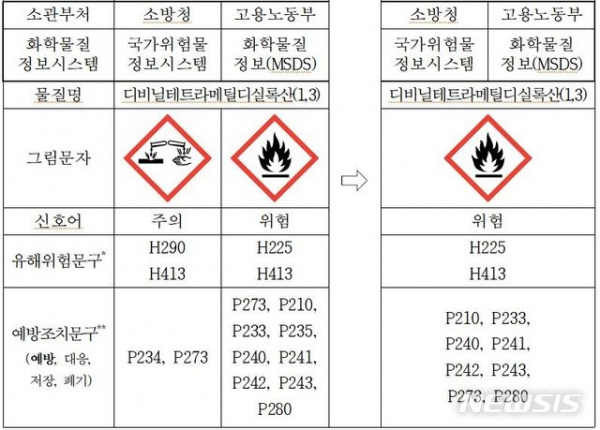
South Korea's National Fire Agency (NFA) and Ministry of Employment and Labor (MOEL) have completed a harmonization project to resolve discrepancies in GHS (Globally Harmonized System) classification and labeling information for 3,181 overlapping chemical substances, effective October 31, 2019. This move eliminates confusion for chemical handlers who previously had to cross-check conflicting data between two government systems, streamlining compliance for importers, distributors, and industrial users of hazardous chemicals in South Korea.
Background of the discrepancy
The NFA's National Hazardous Materials Information System (HAZMAT) lists 6,831 substances, while MOEL's Chemical Information (MSDS) database contains 20,346 substances. Among 3,789 overlapping chemicals, 3,181 (84%) had differing GHS classifications due to variations in regulatory interpretation and enforcement objectives under their respective laws, causing confusion among industry stakeholders.
Harmonization process
In November 2017, both agencies established a unified standard for chemical classification and labeling based on the UN GHS manual. A subcommittee was formed in March 2018, and after 18 months of seven interagency meetings and revisions, the harmonization was finalized. The unified data now ensures consistent hazard information across both systems.
What buyers should watch
Importers and downstream users of chemicals in South Korea should verify that their MSDS and labels align with the newly unified GHS classifications. The harmonization reduces the risk of non-compliance due to conflicting official data, particularly for substances regulated by both the Chemical Substances Control Act (under MOEL) and the Hazardous Materials Safety Management Act (under NFA).
Compliance and logistics signals
A NFA official stated: "With the provision of unified GHS information, the inconvenience and confusion of having to separately search for substance information registered with both agencies when storing and handling chemicals have been eliminated." The agencies plan to regularize comparison and verification of GHS data to maintain consistency in hazard communication going forward.
Source: Read the original report | Published: October 31, 2019