South Korea's position in China's import market has weakened for the second consecutive year, with its market share dropping to 8% in 2021, a 1.9 percentage point decline from 2017. This trend, driven by competition from Taiwan and ASEAN, impacts key export items such as memory semiconductors, synthetic fibers, and paraxylene, signaling challenges for overseas chemical buyers sourcing from South Korea.
Market share decline
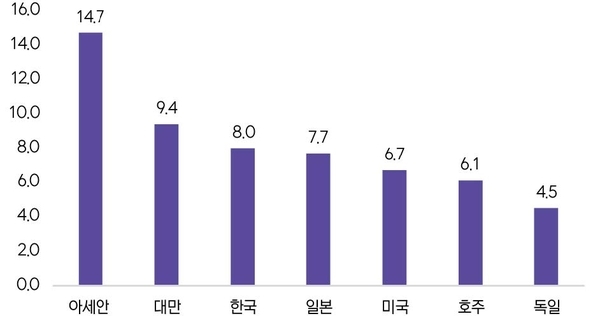
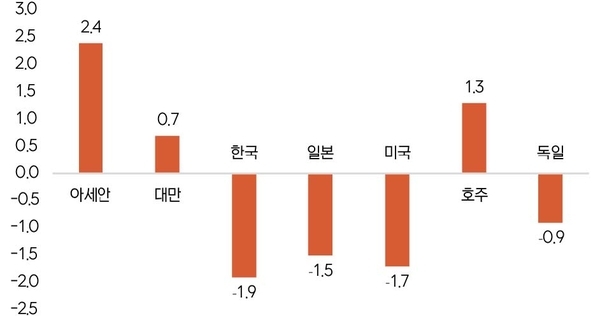
According to a report by the Korea International Trade Association (KITA) on November 8, South Korea's share of China's import market fell to 8% in 2021, down 1.9 percentage points from 2017. This is the largest decline among China's top 10 import sources, surpassing even the U.S. drop of 1.7 percentage points amid trade disputes. Taiwan has held the top spot since 2020.
Key product impact
For key South Korean export items like memory semiconductors, wireless communication components, synthetic fibers, and paraxylene (a raw material for PET bottles), China's overall imports grew, but demand shifted to Taiwan and ASEAN, eroding South Korea's share. In ICT products, South Korea's share fell from 20.5% in 2017 to 17.9% in 2021, the steepest decline among major countries.
Intermediate and consumer goods
Over 80% of South Korea's exports to China are intermediate goods, but while China's intermediate goods imports rose 50.3% from 2017 to 2021, South Korean intermediate goods imports only increased 21.7%. Consumer goods exports also lag, with South Korea's share stuck at around 3%, heavily concentrated in cosmetics (66.1% of consumer goods exports), limiting diversification.
High-tech and chemical products
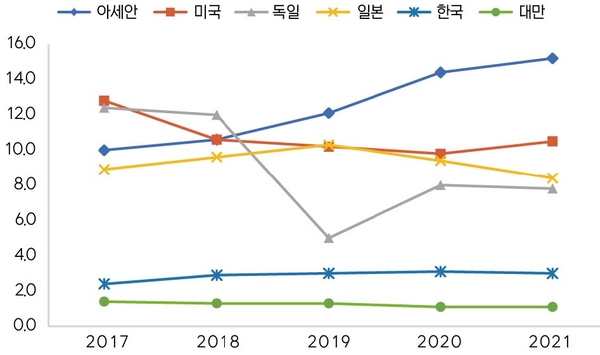
In China's high-tech intermediate goods market, South Korea's share has declined since 2019, allowing ASEAN to overtake it. For high-tech products comprising 30% of China's total imports, South Korea's share is falling, especially in scientific instruments and chemical products, where losses are being absorbed by ASEAN and Japan. Unlike competitors, South Korea lacks any product category with over 20% market share.
What buyers should watch
KITA researcher Arin Kim warned that China's push for self-sufficiency in intermediate goods and reduced processing trade poses long-term structural risks for South Korean exports. Overseas buyers should monitor South Korea's efforts to diversify export items, develop high-value-added products, and pursue additional tariff concessions under the Korea-China FTA, as these could affect supply chain stability and pricing for chemicals and electronics.
Source: Read the original report | Published: June 08, 2022