South Korea's petrochemical export volumes to China are declining as China's massive capacity expansion raises its self-sufficiency rate, squeezing Korean producers already facing global oversupply and weak competitiveness. Industry experts warn that structural restructuring and a pivot to high-value, eco-friendly, and AI-driven operations are critical for survival, with Japan's past restructuring offering a potential blueprint.
Export decline and China dependency
South Korea's annual petrochemical exports have fallen to 37-39 million tons, with the China-bound share shrinking. Exports to China dropped from 17.65 million tons in 2018 to 14.69 million tons in 2023—a 17% decline—before recovering slightly to 15.98 million tons in 2024, still far below historical levels. Despite the drop, China still accounts for about 40% of South Korea's petrochemical exports.
China's capacity surge and cost disadvantage
China began a major ethylene capacity expansion in 2021 through joint ventures with global firms, expected to continue through 2027. In 2022, China surpassed the US to become the world's top ethylene producer with 46 million tons/year, projected to reach 60 million tons in 2025 and 72 million tons by 2027. This oversupply deepens the global imbalance and pressures Korean producers. South Korea's naphtha cracking (NCC)-based production is inherently cost-disadvantaged versus gas-based (ECC) producers in North America and the Middle East, and coal-based (CTO) plants in China. At $100/barrel oil, NCC ethylene costs over $800/ton more than ECC. Geopolitical shocks like the Russia-Ukraine war have widened feedstock spreads. China and the Middle East are also adopting crude-oil-to-chemicals (COTC) integrated plants, further challenging Korean cost structures.
Restructuring moves and Japan's example
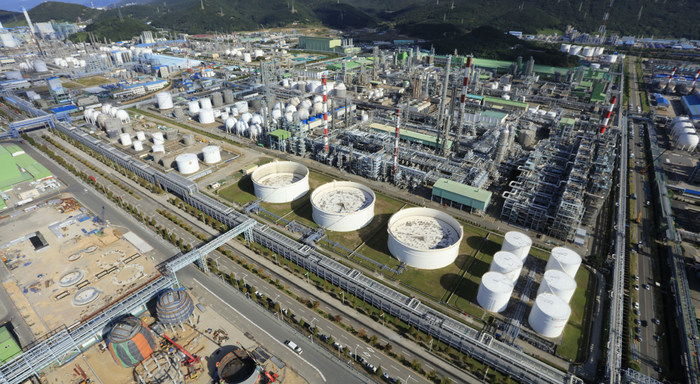
Major Korean petrochemical complexes in Ulsan, Yeosu, and Daesan face overlapping investments and falling utilization rates—from 86% in 2021 to 77% in 2024. Companies like LG Chem, Lotte Chemical, and SKC are divesting overseas assets, selling idle domestic lines, and adjusting portfolios. However, hurdles include local stakeholder interests, lack of buyers, and delayed government support. Japan's restructuring during the 1980s-2000s downturn is cited as a model: temporary regulatory easing, government-led consolidation, and a shift from commodity to high-value specialty chemicals helped the industry recover.
High-value, eco-friendly, and AI transformation
Korean firms are pivoting to new growth areas. LG Chem and Lotte Chemical are investing in secondary batteries, advanced materials, precision chemicals, bioplastics, and plastic recycling. SK Geo Centric is building a recycling cluster in Ulsan and partnering with France's Arkema on functional polyolefins. Kumho Petrochemical focuses on high-performance synthetic rubber for EV tires. S-Oil's $9 billion Shaheen project will start Korea's first COTC plant in 2026, cutting costs and carbon emissions. Chemical recycling of plastics and bio-based plastics are key growth areas, with the bioplastics market forecast to grow over 20% annually. LG, Lotte, and SK affiliates are executing large-scale production conversion roadmaps. AI and digitalization are also being deployed. Global leaders like Shell, Dow, and BASF use AI for predictive maintenance, process control, quality automation, and real-time carbon monitoring. LG Chem and SK Geo Centric are adopting digital twins and supply chain automation to boost efficiency.
What buyers should watch
Overseas buyers should monitor South Korea's restructuring pace and portfolio shifts. As Korean producers exit commodity markets and focus on high-value specialties, supply of basic petrochemicals may tighten, potentially raising prices. Meanwhile, new eco-friendly and advanced material offerings could create sourcing opportunities for formulators and manufacturers seeking sustainable alternatives. Policy support from the Korean government, including tax incentives and antitrust exemptions for M&A, will be critical to the speed and success of this transition.
Compliance and logistics signals
China's continued capacity expansion will keep global petrochemical supply abundant, pressuring margins for NCC-based producers worldwide. Buyers should watch for potential anti-dumping measures or trade disputes as Korean and other producers seek to protect market share. Logistics routes from Korea to China may see reduced volumes, while intra-Asia trade patterns could shift as Korean firms redirect exports to other regions.
Source: Read the original report | Published: July 21, 2025