The Korean petrochemical industry (K-petrochemicals) is facing a severe crisis, as evidenced by the situation at the Yeosu National Industrial Complex, the country's largest production hub. During a visit on June 26, the lunchtime dining district in Yeosu's Museon district, about 3 km from the complex, was unusually quiet, with most restaurants having only one or two tables occupied and many completely empty. A worker from Iksan, North Jeolla, who has been at the complex for years, said, 'Four friends from my hometown worked here together; they've all left, and I'm the only one remaining. How can the local economy survive when people keep leaving?' According to the Korea Industrial Complex Corporation, the number of workers at Yeosu Industrial Complex fell to 16,779 in the second quarter of this year, down 5,077 from 21,856 in the same period last year—a 23.2% drop in just one year. The worker added, 'I'm also preparing to change jobs due to the anxiety.' A small business owner supplying to several domestic companies, who met at Seongsan Park in the afternoon, described the dire situation: 'Work orders have plummeted in recent years. I'm barely surviving by hiring foreign workers with lower labor costs, but I don't know how long I can hold on. This is tougher than the IMF crisis.' On the road leading to the Yeosu complex, only occasional passenger cars were seen, with no large trucks carrying goods. A nearby gas station attendant noted, 'During the boom times, large trucks lined up to come in and out. Now, they are very rare.' The chimneys of factories in the complex, which once frequently emitted smoke, now do so only sporadically. According to the Yeosu Chamber of Commerce and Industry, total sales from the Yeosu complex fell from 101.7 trillion won in 2022 to 87.8 trillion won last year. K-petrochemicals are dying. Although Yeochun NCC (YNCC), a major company in the complex, narrowly avoided bankruptcy by borrowing 300 billion won (150 billion each from its major shareholders Hanwha Solutions and DL Chemical) on June 18, the situation continues to worsen. Bond prices in the petrochemical industry have plummeted as market confidence erodes. Kim Ji-hoon, a senior partner at Boston Consulting Group Korea, warned at a National Assembly forum last month, 'If the downturn persists, only about half of domestic petrochemical companies will survive within three years.' YNCC's cumulative losses from 2022 to last year reached 820 billion won, and with about 510 billion won in debt maturing next year, analysts believe it will struggle to recover independently. Lotte Chemical has also suffered losses of 2 trillion won over three years since 2022, leading Lotte Group to offer its Lotte World Tower in Seoul's Jamsil as collateral for Lotte Chemical's corporate bonds due to a liquidity crisis. According to the Ministry of Trade, Industry and Energy, petrochemical product exports fell from $55.1 billion in 2021 to $48 billion last year. Profitability has deteriorated even more sharply: the industry's operating profit margin dropped from 13.4% in 2021 to 0.6% in 2023. YNCC, once a cash cow with annual operating profits in the trillions of won and average employee salaries near 90 million won, earning it the nickname 'Samsung Electronics of the petrochemical industry,' is now a burden. Its two major shareholders, Hanwha Solutions and DL Chemical, are in conflict over whether to provide further support. Hanwha Solutions prioritizes support, while DL Chemical insists on a careful management diagnosis first.
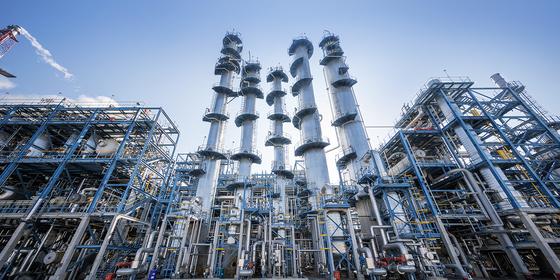
![여천NCC 제2사업장에 위치한 제품저장시설 전경. [사진 여천NCC 홈페이지]](https://pds.joongang.co.kr/news/component/joongang_sunday/202508/30/a3b0d077-896f-43fa-81a3-569bc157fae6.jpg)
Lotte Chemical was also highly profitable at its peak in 2016, even surpassing LG Chem as the industry leader. Both YNCC and Lotte Chemical have a high proportion of general-purpose products like ethylene, propylene, and naphtha cracking (NCC), which allowed them to maximize profits during boom times and expand rapidly. However, they overlooked that general-purpose products are easier for latecomers like China to overtake, unlike high-value-added products requiring advanced technology. Since the 2010s, China's petrochemical industry, backed by economic growth and government support, has aggressively expanded NCC capacity. China now holds an advantage in general-purpose product production due to its superior production capacity and lower labor costs. China produced 51.74 million tons of ethylene in 2023, about 60% more than its own 2020 output and roughly four times South Korea's ethylene production capacity of 12.8 million tons. This has fueled oversupply and price declines, contributing to the struggles of K-petrochemicals, including major companies like YNCC and Lotte Chemical, in export markets. According to the Korea Petrochemical Industry Association, the share of South Korea's petrochemical exports to China fell from 47.8% in 2010 to 37.3% in 2023. Domestic NCC utilization rates have dropped from 93.1% in 2021 to 81.7% in 2022 and 74.0% in 2023. Cho Yong-won, a research fellow at the Korea Institute for Industrial Economics and Trade, analyzed, 'China's recent economic slowdown has deepened the downward price spiral for petrochemical products, creating a vicious cycle.' The entry of Middle Eastern countries has compounded the problem. Saudi Arabia, the UAE, and Kuwait, as oil producers, have a raw material cost advantage and have been investing heavily in petrochemicals as part of their industrial diversification, further exacerbating oversupply. Combined with the impact of low global oil prices, the Ministry of Trade, Industry and Energy reported that petrochemical export unit prices fell 12.6% year-on-year last month. The combined operating loss (petrochemical division) of the four major domestic petrochemical companies—LG Chem, Lotte Chemical, Hanwha Solutions, and Kumho Petrochemical—grew from 70 billion won in the first half of last year to 476.2 billion won in the first half of this year, a sevenfold increase in just one year.

In response, the government signed a voluntary agreement on June 20 with 10 major petrochemical companies aimed at restructuring the industry, targeting a reduction of up to 3.7 million tons of NCC capacity. Companies are required to submit their own restructuring plans to the government by year-end. Deputy Prime Minister and Minister of Economy and Finance Koo Yoon-cheol emphasized, 'If the industry undertakes restructuring with a resolve to cut deep, the government will provide full support.' Some companies have begun voluntary restructuring. On June 27, industry sources said LG Chem is surveying workers at its Yeosu and Daesan plants for voluntary retirement. Companies are also reportedly discussing asset sales or mergers. An industry insider said, 'K-petrochemicals account for 7-8% of South Korea's total exports and are crucial for protecting the declining regional economy. We are working on specific restructuring directions.' However, some critics argue that a private-sector-led approach relying on corporate voluntarism has limitations. A senior business figure who requested anonymity said, 'With external headwinds like U.S. reciprocal tariffs likely to sustain demand weakness, self-rescue measures by companies with immediate interests at stake may not be effective. Companies cannot strategically restructure on a large scale, and there are many regulations. It would be better for the government to take the lead.' He cited the delayed decision-making at YNCC due to disagreements between its major shareholders as an example. However, the government has not yet provided support measures requested by the industry, such as electricity rate cuts for crisis-hit industrial complexes or flexible application of the Fair Trade Act (e.g., exemption from collusion rules) to facilitate efficient restructuring. Some experts point to Japan as a benchmark. Japan, which faced a petrochemical crisis earlier than South Korea, began government-led restructuring in 2014. Through legislation, it provided tax credits, tax deferrals, subsidies through funds, and electricity rate cuts to support corporate integration, division, and facility reduction/efficiency. As a result, Japan's ethylene production fell from 7.43 million tons in 2015 to 6.82 million tons in 2020, with a target of 4.3 million tons by 2028. Many Japanese companies, such as Shin-Etsu Chemical, which pivoted to semiconductor materials and became the world's top silicon wafer maker, successfully escaped the blood competition with China by moving into high-value-added products. Lee Duk-hwan, professor emeritus of chemistry at Sogang University, said, 'This is the last golden time for petrochemical industry restructuring. The government must provide institutional support, such as deregulation and incentives, for corporate restructuring. It should start by relaxing the Fair Trade Act's collusion provisions that hinder production volume coordination among companies.' Kim Yong-jin, professor at Dankook University's Graduate School of Science and Technology Policy, emphasized, 'The current downturn is different from past cyclical booms and busts. K-petrochemicals have lost competitiveness and may not survive. The government must provide clear guidance and take the lead in promoting product high-value-added for fundamental export competitiveness recovery.'
Source: Read the original report | Published: August 30, 2025