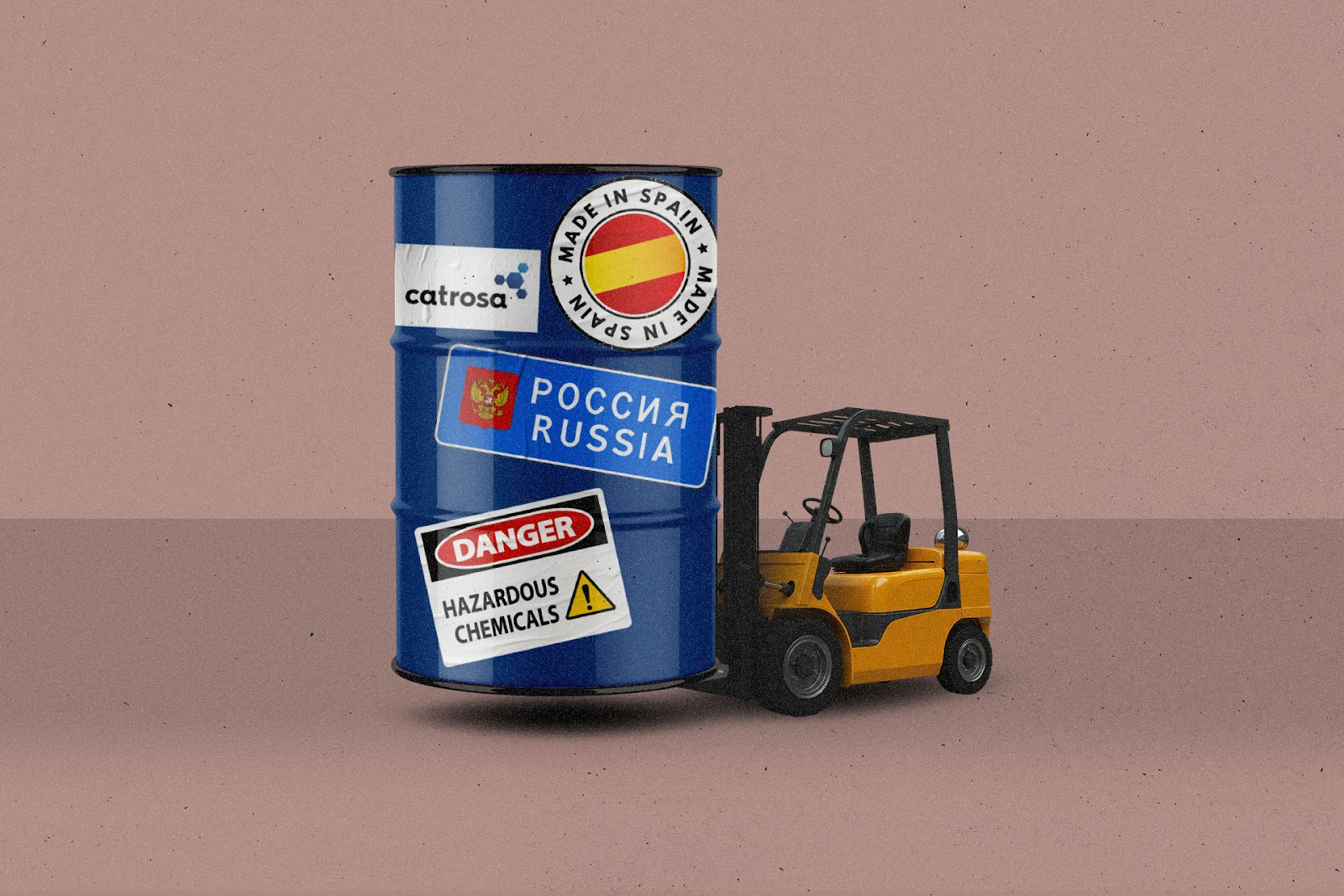
A network of companies led by a Russian-Spanish family has been selling chemicals to Russian weapons developers and intelligence-linked agencies, according to a joint investigation by OCCRP, Important Stories, the Belarusian Investigative Center, and Slidstvo.info. The probe reveals how dual-use chemicals, including those used in nerve agents like Novichok, reached Russian entities despite EU export controls. This development signals heightened compliance risks for chemical suppliers and logistics firms trading with Russia.
Network structure and key players
The Catrosa network comprises companies registered in Spain and Russia, including Complexe Sancu SL, a Spanish firm owned by Maria Oleinikova and her children. Originally set up in 2009 to export Spanish wine and tapas to Russia, Complexe Sancu also shipped chemicals to Catrosa Reactiv, a Russian chemical company majority-owned by Oleinikova. Between 2022 and 2024, Catrosa Reactiv received at least 36 shipments of sanctioned chemicals from Spain, including one directly from Complexe Sancu.
Dual-use chemicals and end users
Among the chemicals exported was diethylamine, a precursor for the VX nerve agent, and N-methyl-2-pyrrolidone (NMP), a controlled dual-use chemical restricted under EU sanctions. Investigators identified the Russian buyers as chemical weapons manufacturers and intelligence agencies involved in the Novichok program. The chemicals also appear on EU restricted lists for Syria, where the Assad regime has used chemical weapons.
Logistics and supply-chain evasion
Catrosa used European logistics firms to route shipments to Russia via Poland and Belarus. In April 2024, STS Logistics LLC, a Moscow-based company, was identified as a facilitator for shipments from Complexe Sancu to Catrosa Reactiv. STS Logistics has also been linked to Russia's acquisition of microelectronics for its war effort, according to Ukrainian watchdog NAKO.
What buyers should watch
Chemical importers and distributors should review their supply chains for exposure to entities linked to the Catrosa network. The investigation highlights the risk of dual-use chemicals being diverted to prohibited end users. Companies sourcing from Spain, Italy, or the Philippines should verify that their suppliers are not using Complexe Sancu, Scharlab SL, or Catrosa Reactiv as intermediaries. Enhanced due diligence on logistics partners routing through Poland or Belarus is also advised.
China sourcing context
Catrosa recruited a Russian procurement manager, Dennis Volkoff, based in Thailand, to diversify suppliers in Asia. His LinkedIn profile lists contracts with Chinese firms such as Concord Technology Tianjin Co and Liaoning Oxiranphex Inc., as well as Indian suppliers like Bimal Pharma and Deepak Fertilizers. This indicates that Asian chemical producers may be inadvertently supplying the network, underscoring the need for rigorous end-user checks.
Source: Read the original report | Published: September 30, 2025