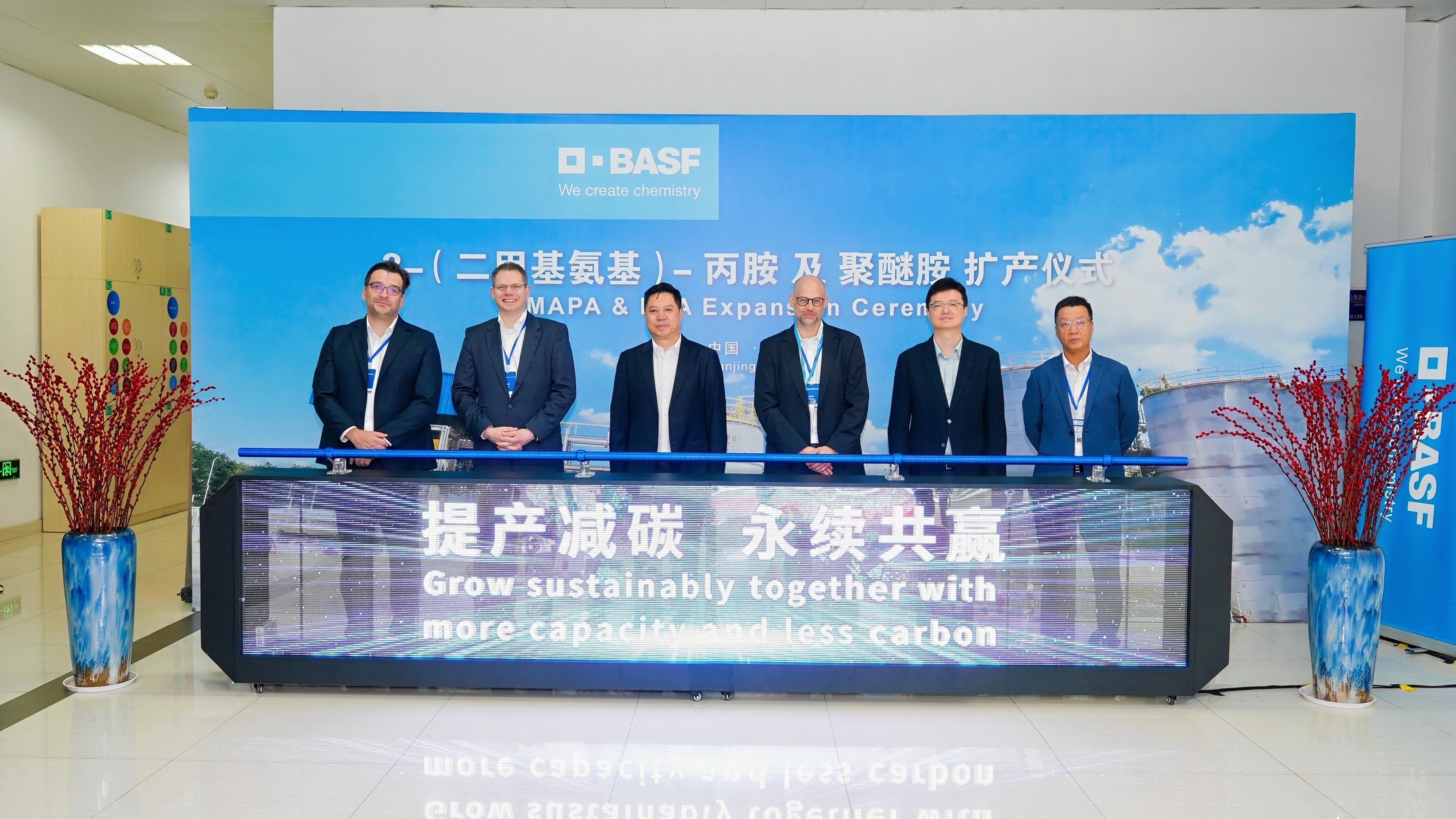
BASF has doubled its annual DMAPA capacity and increased PEA capacity by 25% at its Nanjing, China site, with the expanded plant starting operations in July 2025. The move strengthens supply reliability for Asian buyers of these key intermediates used in personal care, agrochemicals, coatings, and composites, while also cutting product carbon footprint by 4% through 100% renewable electricity.
Capacity expansion details
The expansion, celebrated on October 16, 2025, raises BASF's global DMAPA capacity by over 20% to approximately 85,000 metric tons per year, reinforcing its position as a top global producer. PEA capacity at Nanjing has grown by about 25%. The site now serves rising customer demand across Asia Pacific with enhanced reliability and safety.
Product applications and market relevance
DMAPA is a key building block for betaines used in mild liquid soaps, shampoos, and dishwashing detergents, as well as in water treatment chemicals, agrochemicals, lubricant additives, polyurethane foam, and epoxy resin hardeners. PEA, sold under the Baxxodur® brand, is an intermediate for epoxy hardeners in plastics, polyurea coatings, adhesives, reaction injection molding, and wind turbine blade composites.
Sustainability and carbon footprint reduction
Since 2023, BASF has switched to 100% renewable electricity for the entire amine portfolio at Nanjing, covering DMAPA, PEA, tert-butylamine (tBA), n-octylamine (NOA), and 1,2-propylenediamine (1,2-PDA). This change cuts annual CO₂ emissions by about 9,800 metric tons versus the 2020 baseline and reduces the average product carbon footprint (PCF) by roughly 4%. The switch requires no changes from customers and helps them lower Scope 3 emissions.
What buyers should watch
Asian buyers of DMAPA and PEA can expect improved supply security and shorter lead times from the expanded Nanjing site. The use of 100% renewable electricity also offers a lower-carbon sourcing option without formulation changes. BASF's PCF calculation follows ISO 14067:2018 and has been certified by TÜV Rheinland, providing verified sustainability data for downstream reporting.
China sourcing context
Nanjing is a key production hub for BASF in China, serving the fast-growing Asia Pacific market. The site's amine portfolio now benefits from both capacity expansion and renewable energy integration, making it a competitive source for importers and formulators seeking reliable, lower-carbon intermediates for personal care, industrial coatings, and composite materials.
Source: Read the original report | Published: October 28, 2025