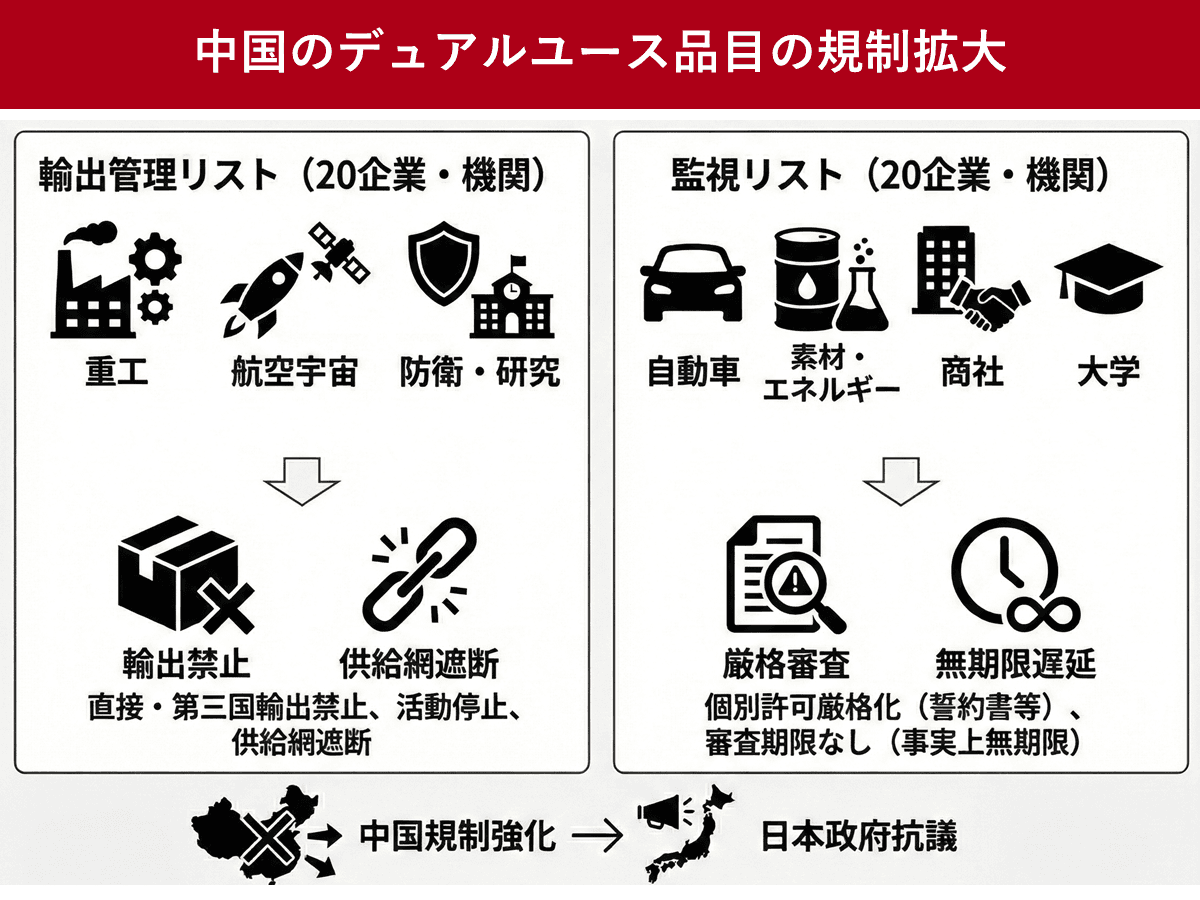
China's Ministry of Commerce on February 24, 2026, added 20 Japanese companies and institutions to its dual-use export control list and another 20 to a monitoring list, escalating trade restrictions that began in January. This move, linked to Japan's defense buildup and recent political statements, directly impacts chemical supply chains for importers and distributors of dual-use items, including rare metals and specialty chemicals, by blocking or delaying exports to key Japanese defense and aerospace firms.
Regulatory background
China's Dual-Use Item Export Control Regulations, effective December 1, 2024, consolidated four previous laws covering nuclear, missile, biological, and chemical items into a single framework. The regulations cover goods, technology, and services that can be used for both civilian and military purposes, including transfers within China, deemed exports by Chinese citizens or organizations abroad, transit, transshipment, and re-export. Authorities can also require controls on foreign-made products containing Chinese-origin dual-use items.
Exporters must obtain individual licenses, general licenses, or export certificates. Companies that fail to cooperate with end-use verification can be placed on a list and face restricted licensing. Violations carry fines up to 3 million yuan (approximately $415,000).
Entities on the export control list
The 20 entities added to the export control list span Japan's defense, space, and aviation sectors, including Mitsubishi Shipbuilding, Mitsubishi Heavy Industries (multiple divisions), Kawasaki Heavy Industries, IHI (multiple subsidiaries), Fujitsu, Japan Marine United, the National Defense Academy, and JAXA. Immediate measures include a ban on direct exports from China to these entities, a ban on third-country transfers of Chinese-origin dual-use items to them, and a halt to ongoing activities. Any exceptions require special approval from the Ministry of Commerce, effectively cutting supply chains.
Entities on the monitoring list
The monitoring list includes 20 additional entities such as Subaru Corporation, ENEOS, ITOCHU Aviation, Tokyo Institute of Science, Mitsubishi Materials, TDK, Mitsui Bussan Aerospace, Nitto Denko, NOF Corporation, and Nacalai Tesque. For these entities, Chinese exporters cannot use general export licenses or simplified registration; they must submit a risk assessment report and a written pledge that the dual-use items will not be used to enhance Japan's military capabilities. The review period for such applications is no longer limited, allowing Chinese authorities to delay approvals indefinitely.
What buyers should watch
Chemical importers and distributors should monitor the expanded scope of controlled items. While China has not defined exactly which dual-use items are covered, rare metals and specialty chemicals used in defense and aerospace are likely targets. Companies sourcing rare earths, rare metals, or advanced chemical intermediates from China for Japanese end-users should verify whether their customers are on either list. Supply chain disruptions may extend to third-country processing or re-export of Chinese-origin materials.
Compliance and logistics signals
The new regulations impose reporting obligations on exporters when foreign governments request on-site inspections. Non-compliance can result in fines up to 3 million yuan. Logistics providers handling dual-use chemicals or materials should ensure end-use documentation is complete and that consignees are not on the restricted lists. The indefinite review period for monitoring-list entities creates uncertainty for delivery timelines.
China sourcing context
China's actions follow Japanese Prime Minister Takashi's remarks on Taiwan and his February 20 policy speech outlining plans to revise Japan's three national security documents by 2026, including a review of defense equipment transfer principles. Japan's defense production relies on Chinese imports for rare earths and other critical materials, highlighting supply chain vulnerabilities. The Japanese Foreign Ministry has protested and demanded the measures be withdrawn.
Source: Read the original report | Published: February 25, 2026