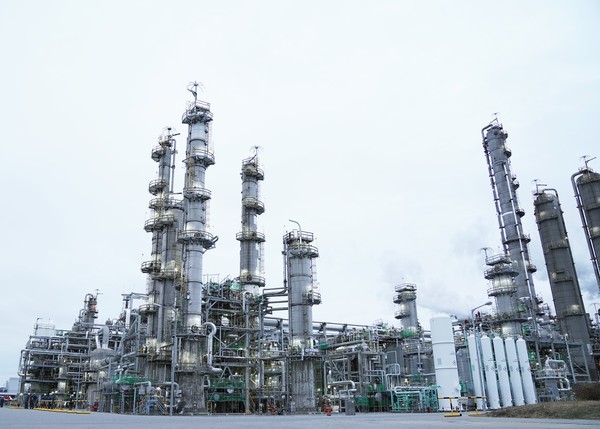
South Korea's petrochemical industry must complete restructuring within this year to lower fixed-cost burdens and minimize the impact of global capacity additions, analysts warn.
According to Lotte Chemical's recent earnings conference call, polypropylene (PP) capacity is expected to increase by 6 million tonnes, high-density polyethylene (HDPE) by 5 million tonnes, and linear low-density polyethylene (LLDPE) by 3 million tonnes this year. These additions represent 6–10% of global demand, and assuming demand growth of 4–5%, supply growth will outpace demand.
Domestic restructuring efforts focus on minimizing damage from stagnant demand and persistent oversupply. The industry expects global capacity expansion, which had slowed, to resume this year. Korea Credit Rating forecasts ethylene capacity will grow by an average of 10 million tonnes annually from this year through 2028, and propylene by 8 million tonnes annually through 2027. Ethylene oversupply, which remained at 40 million tonnes from 2024 to this year, is estimated to exceed 50 million tonnes from next year.
China, a key market for Korean petrochemical products, plans to add over 20 million tonnes of ethylene capacity by 2028 while cutting only about 3 million tonnes. China is expected to introduce a naphtha consumption tax and abolish export VAT rebates for some chemical products this year. The naphtha tax will be levied and then refunded, while export VAT rebates may be abolished or reduced, increasing cost burdens for Chinese producers and potentially boosting chemical imports.
However, these policy impacts may be short-lived. Lotte Chemical stated, "The naphtha consumption tax could increase Chinese import demand in the short term, but in the long term, lower operating rates will limit the effect. The export VAT suspension may lead to a surge in pre-suspension exports, and while solar panel imports are already declining, long-term impacts are expected to be limited."
Falling crude oil prices this year add further pressure. Average crude oil prices dropped from $80/barrel in January last year to $65/barrel in November, and are expected to average $60/barrel this year. This decline, driven by weak demand despite OPEC+ maintaining supply, is expected to drag down petrochemical product prices and profitability. Lotte Chemical's Q4 sales fell 1.7% year-on-year, while operating profit plunged 85%.
Industry attention is also on when S-OIL's Shaheen Project volumes will be released. The Shaheen Project uses TC2C (Thermal Crude to Chemicals) technology to convert crude oil directly into petrochemical feedstocks, offering cost competitiveness from the raw material stage. S-OIL said facilities capable of producing 1.8 million tonnes of ethylene, 770,000 tonnes of propylene, and 280,000 tonnes of benzene will be completed in the first half of this year, and it is currently in the "customer delivery negotiation stage." On April 10, S-OIL announced a 5.5 trillion won long-term polyethylene (PE) supply agreement with SABIC, a Saudi Aramco affiliate, for 2026–2030, with products to be produced at the Shaheen Project.
Compared to the announced global expansions, domestic restructuring is progressing slowly. In the Daesan area, 1.1 million tonnes of capacity are scheduled for reduction, including volumes from HD Hyundai Chemical, a joint venture between Lotte Group and HD Hyundai Group. In Yeosu, only 470,000 tonnes from Yeochun NCC are planned. This falls 1 million tonnes short of the government's lower restructuring target of 2.7 million tonnes, and Korea Credit Rating has noted that even the upper target of 3.7 million tonnes is the minimum needed to avoid global oversupply.
Source: Read the original report | Published: February 10, 2026