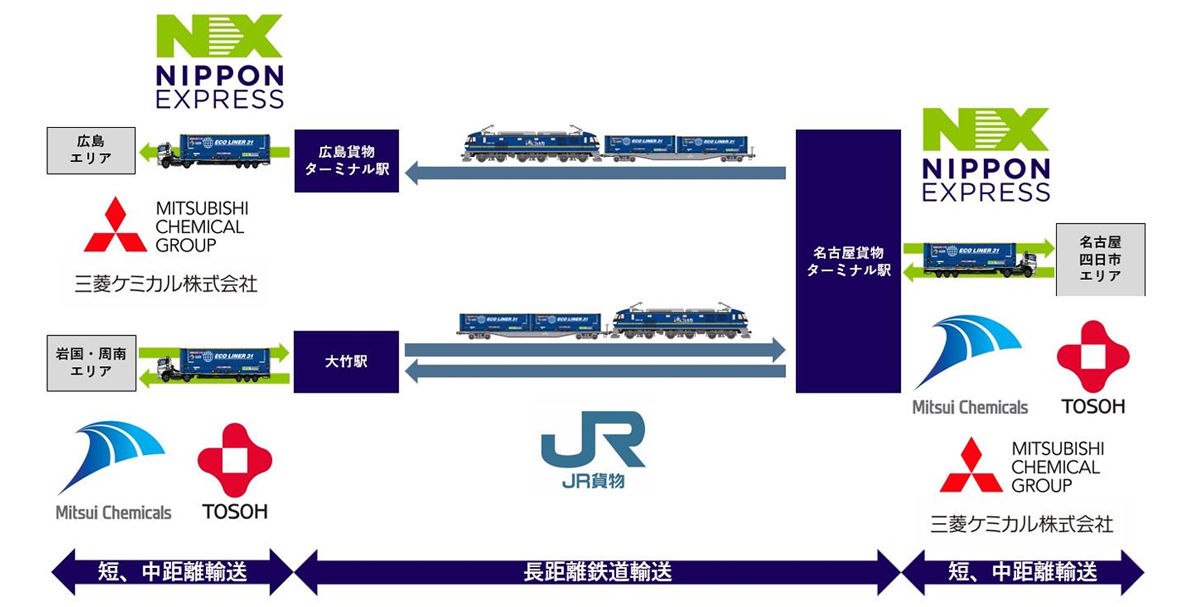
NIPPON EXPRESS HOLDINGS (NXHD) announced on March 24 that a demonstration project under the Chemical Working Group (WG) of the Physical Internet Realization Council, led by Japan's Ministry of Economy, Trade and Industry and Ministry of Land, Infrastructure, Transport and Tourism, has confirmed the feasibility of round-trip rail transport using the same container. This breakthrough offers overseas chemical buyers a more sustainable and cost-efficient logistics alternative for moving bulk chemicals between industrial hubs in Japan.
Demonstration scope and participants
The Chemical WG includes 86 companies, one university, the Japan Chemical Industry Association, the Japan Petrochemical Industry Association, and relevant government departments. NXHD group company Nippon Express participated as a logistics provider. The demonstration ran from August 2025 to January 2026, focusing on joint rail logistics in the Tokai and Chugoku regions.
Trial structure and methodology
Participants included Mitsubishi Chemical, Tosoh, Mitsui Chemicals, JR Freight, and Nippon Express. Two types of trials were conducted: a "single trial" where each company operated its own transport route independently, and a "round trial" where the same container was used for continuous round-trip operations across all three shippers' routes. The routes connected freight stations in Nagoya (Aichi Prefecture) with Hiroshima City and Otake City (Hiroshima Prefecture). Desk-based verification also created operational workflows, contingency switching criteria, and optimized schedules based on historical data.
Key results and environmental benefits
The joint rail transport scheme proved that three shippers can share a single container for continuous round-trip operations. Modal shift from truck to rail achieved a 57% reduction in CO2 emissions, a 74% reduction in truck transport distance, and a 64% reduction in truck driver duty hours. These figures highlight significant sustainability and efficiency gains for chemical supply chains.
Challenges for implementation
When using 31-foot containers, the limited number of freight stations that can handle them results in longer drayage distances, reducing the benefits of rail transport. Building a scheme based on stations capable of handling 31-foot containers is a key challenge. Additionally, maintaining high container utilization requires stable round-trip cargo volumes, which demands load leveling and relaxed logistics conditions from shippers.
What buyers should watch
Overseas chemical importers and distributors should monitor the expansion of 20-foot container options in this scheme, as they offer greater flexibility and station access. The project team plans to continue developing the framework and securing backhaul cargo beyond the chemical industry. This could lead to more reliable, lower-carbon, and cost-competitive rail logistics for chemical products moving between major Japanese industrial zones.
Source: Read the original report | Published: March 24, 2026