A federal grand jury in the Southern District of Ohio unsealed an indictment on March 24, 2026, charging two Chinese chemical companies and six individuals with conspiracy to distribute fentanyl, money laundering, and material support to a foreign terrorist organization. This marks a significant escalation in US enforcement against upstream chemical suppliers, signaling that overseas buyers and distributors of fentanyl precursors now face terrorism-financing exposure alongside traditional drug-trafficking charges.
Indictment details and defendants
The indictment names Shandong Believe Chemical Company PTE Ltd. and Shandong Ranhang Biotechnology Co. Ltd., along with six Chinese nationals: Hanson Zhao, Gao Yanpeng, Xia Yi, Zhang Jian, Wang Zhaolan, and Zhang Chunhai. Prosecutors allege the companies operated as legitimate online pharmacies and chemical suppliers while knowingly marketing fentanyl precursors and cutting agents to drug traffickers, including the Cártel del Golfo (CDG), also known as the Gulf Cartel.
Terrorism financing charge and legal basis
The material support charge under 18 USC 2339B became applicable after the US Secretary of State designated the CDG as a foreign terrorist organization on February 20, 2025. Prosecutors claim the defendants continued supplying precursors and cutting agents to the CDG after that designation and with knowledge of it. This case signals that US prosecutors are applying FTO designations against upstream foreign suppliers, not just cartel members or direct associates.
Cutting agents and potency multipliers
The indictment specifically mentions medetomidine, a veterinary tranquilizer unapproved for human use in the US, as a cutting agent supplied by the defendants. One kilogram of medetomidine can transform a single kilogram of fentanyl and inert filler into dozens of kilograms of street-ready mixture while maintaining or increasing potency. This combination of precursor supply and performance-enhancing cutting agents aligns with documented drug precursor manufacturer typologies.
Cryptocurrency and money laundering
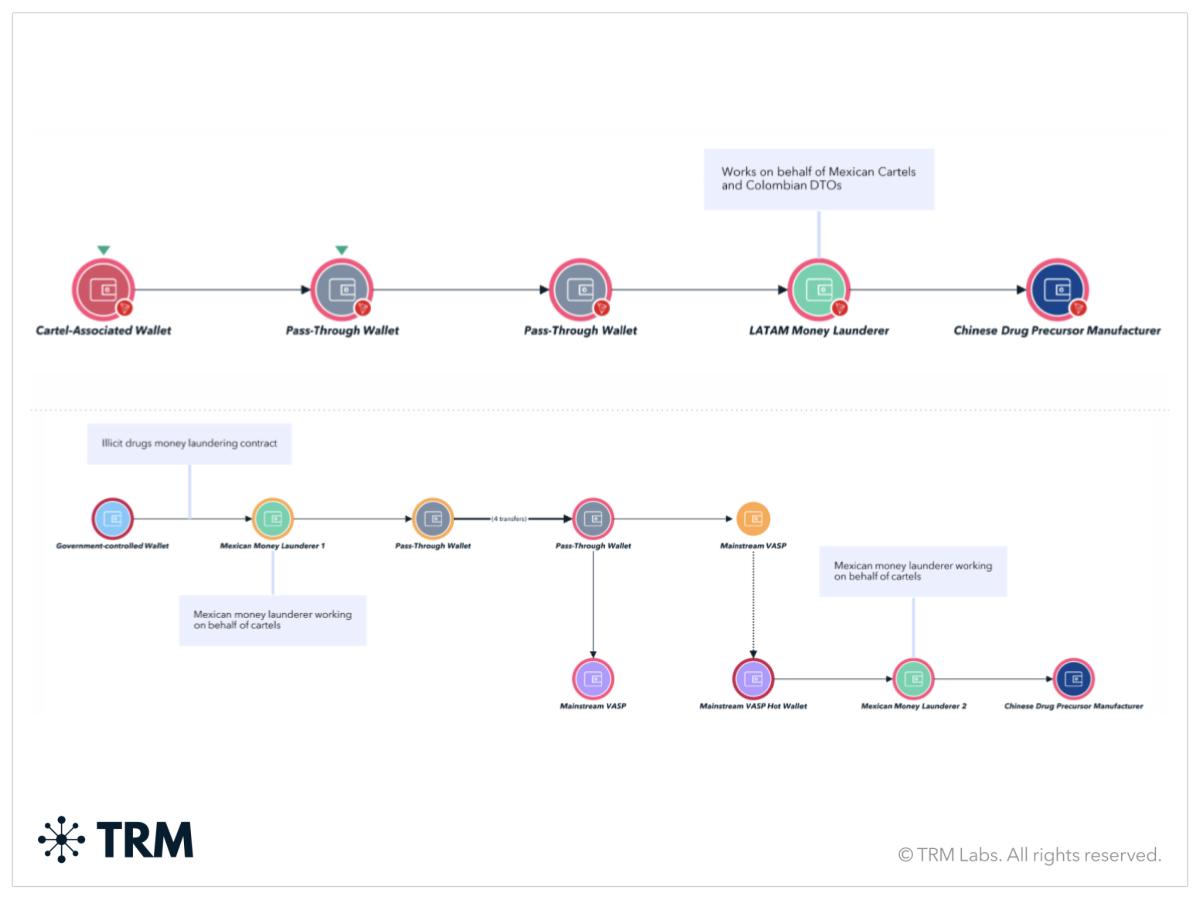
Cryptocurrency was central to the alleged payment infrastructure, with funds flowing through a multi-wallet layering chain before conversion to foreign currency. TRM's research shows approximately 97% of drug precursor manufacturers accept cryptocurrency, with on-chain inflows growing from USD 30.9 million in 2023 to USD 39.1 million in 2025. This laundering typology is consistent with patterns observed across cartel-linked networks.
What buyers should watch
For chemical importers, distributors, and trading companies, this indictment signals that US enforcement is increasingly targeting the upstream supply chain — foreign suppliers, payment facilitators, and wallet holders — not just cartel members directly. Transactions linked to designated FTOs now carry potential exposure under terrorism financing statutes alongside drug trafficking and AML frameworks. Robust transaction monitoring and screening against designated entities and associated addresses are key compliance tools.
Source: Read the original report | Published: March 25, 2026