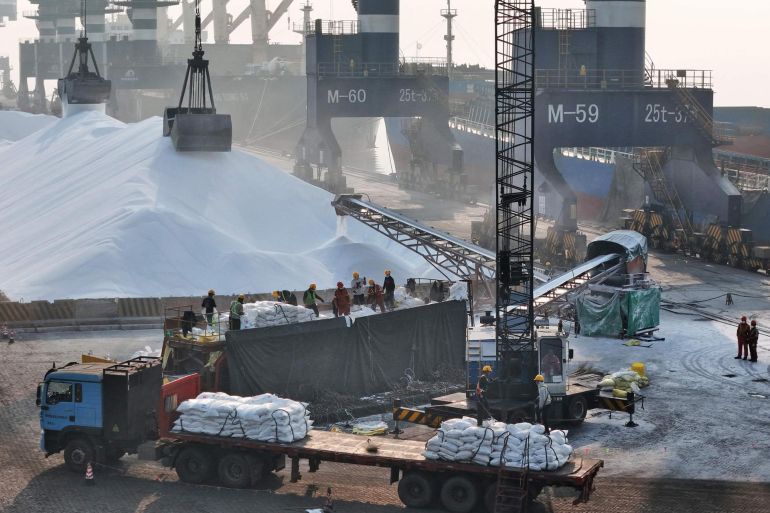
China has issued export quotas for urea fertilizer, a move that could ease global price spikes for one of agriculture's most widely used inputs, according to Reuters sources. The decision comes after supply disruptions linked to the US-Israel war on Iran, offering relief to importers like India that rely heavily on Middle Eastern shipments through the Strait of Hormuz.
Export quota details
China, a top global fertilizer producer and exporter, banned most fertilizer exports in March 2026 to protect domestic farmers from price surges caused by the Strait of Hormuz closure. The new quotas signal authorities' confidence in sufficient local supplies to allocate some for export without straining the domestic market during a sensitive farming season. Two Chinese urea producers told Reuters they received export quotas but declined to provide further details. An Indian importer confirmed that the Chinese government issued a notification allowing urea exports, without disclosing specifics.
Market and price context
Domestic urea prices in China remain well below global levels. The World Bank reported that the fertilizer price index rose over 12% in Q1 2026, reaching its highest since October 2022, driven mainly by Hormuz-related export disruptions. Urea prices exceeded $850 per metric ton in April 2026, up 80% since February, the highest since April 2022. The bank projects urea prices will rise about 60% in 2026 before declining in 2027 as Middle Eastern exports recover and natural gas prices moderate.
India's strategic interest

India, which imported over 40% of its urea from the Middle East last year, is particularly vulnerable to Hormuz disruptions. In March 2026, India asked China to allow urea sales. A senior official at an Indian fertilizer company stated: "We will prefer Chinese supplies in the current situation because shipments are much more predictable, they don't need to pass through the Strait of Hormuz, and are therefore likely to arrive on time." China's geographic proximity and distance from conflict zones make it a preferred supplier for India.
Supply-chain impact
Multiple fertilizer industry sources and social media accounts indicate that approximately 1.5 million tons of urea will be allocated for export. StoneX Consulting reported that China exported 4.9 million tons of urea in 2025, below its historical range of 5-5.5 million tons, which typically accounts for about 10% of global urea exports. The Strait of Hormuz disruption affects a significant portion of global fertilizer trade: countries before the strait account for 34% of global urea trade, 23% of ammonia trade, 49% of sulfur trade, and 18% of monoammonium and diammonium phosphate trade.
What buyers should watch
The FAO warned that Hormuz disruptions cause interconnected shocks in energy, fertilizer, and food markets. FAO Chief Economist Máximo Torero said global fertilizer prices could increase by an average of 15-20% in H1 2026 if the crisis persists. The FAO called for diversifying fertilizer import sources, strengthening regional reserves, and avoiding export restrictions. Importers should monitor China's quota allocation process and shipping logistics, as Chinese urea offers a more predictable alternative to Middle Eastern supplies amid ongoing geopolitical tensions.
Source: Read the original report | Published: May 27, 2026