China's Chemical Supply Chain Behind the US Fentanyl Crisis
Key facts
- A Congressional Research Service report from October 2026 identifies China as a primary source of illicit fentanyl precursor chemicals for Mexican cartels
- The U.S. Centers for Disease Control and Prevention estimates that 37,393 Americans died from synthetic opioid overdoses in 2025, with fentanyl causing the majority
- A federal jury in New York found two Chinese defendants guilty of importing fentanyl precursors and money laundering on February 3, 2025
- Chen was sentenced to 15 years in prison on August 22, 2025, while Wang received a 25-year sentence on September 18, 2025
- Bloomberg reports that Chinese chemical companies may be evading U.S. export controls by changing corporate names or using alternative production channels in Southeast Asia
A transnational supply chain linking Chinese chemical manufacturers to Mexican drug cartels and ultimately to the U.S. market is under sustained investigation by American law enforcement agencies. A report released in October 2026 by the Congressional Research Service (CRS) indicates that China remains a primary source of illicit fentanyl precursor chemicals. Transnational criminal organizations, operating primarily within Mexico, utilize these raw materials to manufacture fentanyl, which is then smuggled into the United States.
The U.S. Centers for Disease Control and Prevention (CDC) estimates that approximately 37,393 Americans died from synthetic opioid overdoses in 2025, with fentanyl and related substances accounting for the majority of these fatalities. Although the death toll has declined significantly from previous peaks, fentanyl continues to pose a substantial public health threat to the nation.
An investigative report published by Bloomberg on Friday, November 13, suggests that despite intensified U.S. efforts to disrupt the fentanyl precursor supply chain, certain Chinese chemical companies may continue their involvement by changing corporate names, establishing new entities, or altering their business operations.
The investigation centers on an undercover operation uncovered by the U.S. Drug Enforcement Administration (DEA) in 2023. The report is based on thousands of pages of judicial documents and interviews with multiple individuals involved in the case. Most interviewees requested anonymity to discuss the details of the law enforcement investigation.
Chinese Firms Sold Fentanyl Precursors to DEA Undercover Agents
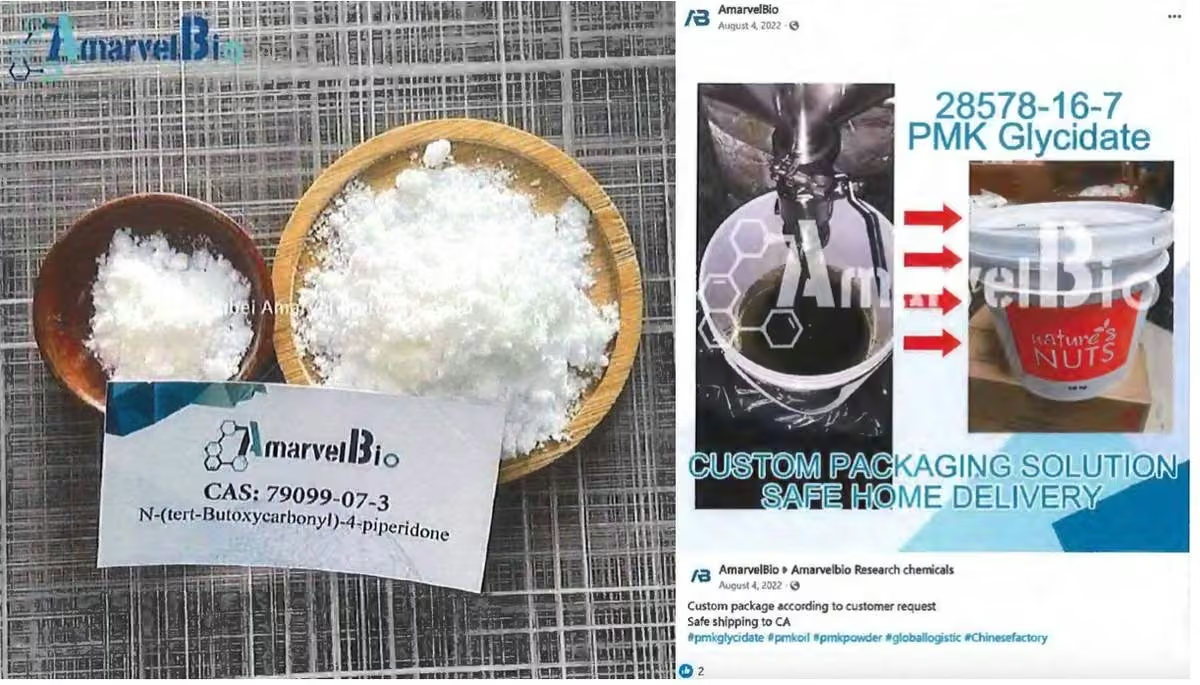
A federal indictment released by the U.S. Department of Justice reveals that in late 2022, Drug Enforcement Administration (DEA) agents made contact with Hubei Amarvel Biotech Co. Ltd., a chemical manufacturer based in Wuhan, Hubei Province, through an encrypted messaging platform.
During the initial exchanges, the undercover officers explicitly informed the company’s sales representative that the purchased chemicals were intended for the production of fentanyl. The representative acknowledged this specific use but proceeded to negotiate the terms of the deal. The parties subsequently arranged for the shipment of chemical precursors from China to the United States, with payments to be settled in cryptocurrency.
In March 2023, Qingzhou Wang, the company’s principal executive, and Yiyi Chen, its marketing manager, traveled to Bangkok, Thailand, to meet with the DEA operatives. According to the indictment, the agents posed as a superior of a fentanyl manufacturer during the discussion, which focused on the potential for large-scale supply of fentanyl precursor chemicals. Even when the undercover agents mentioned a desire to alter the fentanyl manufacturing formula and cited reports of several U.S. customers who had allegedly died, Wang and Chen stated that the company maintained a broad client base in the United States and Mexico and could provide technical assistance for fentanyl production.
Following the meeting, the two sides agreed to a transaction involving approximately 210 kilograms of fentanyl precursor chemicals, to be paid for in cryptocurrency. On May 5, 2023, DEA agents seized the shipment at a warehouse near Los Angeles, California. Laboratory analysis confirmed that the cargo contained a precursor chemical capable of being used to manufacture fentanyl analogs.
The Department of Justice stated that if the seized materials had been processed into fentanyl at the ratios discussed by the undercover agents, the yield would have been approximately 50 to 55 kilograms of the finished drug, equating to roughly 25 million potentially lethal doses.
The international undercover operation subsequently expanded to Fiji. On June 8, 2023, Wang and Chen traveled to the island nation to negotiate a plan for the monthly supply of several tons of precursor chemicals. Fijian authorities expelled the two individuals that same day, after which they were taken into custody by the DEA. The following day, they appeared in court in Hawaii, U.S.
On February 3, 2025, a federal jury in New York found both defendants guilty of importing fentanyl precursors and money laundering. On August 22 of that year, Chen was sentenced to 15 years in prison. Wang received a 25-year prison sentence on September 18. Both defendants are Chinese citizens.
Legacy Firms Halt Operations as New Entities Suspected of Continuing Trade
A recent investigation by Bloomberg News indicates that Hubei Jingao Biotechnology Co., Ltd. has ceased operating under its original name following the exposure of the case. However, Wuhan Ruichi Technology Co., Ltd., a chemical company in Wuhan linked to former sales personnel from the original firm, appears to have assumed some of the related business activities.
This development has raised questions about whether the companies involved in the case are continuing their chemical trade by changing corporate names and establishing new business platforms.
The investigation also highlights a distinctive feature of these illicit supply chains: the individuals selling fentanyl precursor chemicals to drug cartels are not necessarily traditional drug lords operating in the shadows. Instead, they may be highly educated managers and marketing professionals employed by chemical companies.
According to Bloomberg, Chen Yiyi studied in Italy, earning a master’s degree in communication from the University of Bologna. Upon returning to China, she worked in online marketing, leading a conventional nine-to-five life as a regular office employee.
The companies involved also maintained the operational structure of typical private enterprises, including corporate websites, marketing departments, technical support, and even employee events such as New Year parties. Yet, these seemingly normal business operations were utilized to recruit drug dealers, sell chemical precursors, and arrange for disguised cargo and cross-border transportation.
Based on case documents from the U.S. Department of Justice, Wang Qingzhou was the primary executive of the company, while Chen Yiyi served as the marketing manager. A separate sales representative was responsible for direct client interactions. The Department of Justice noted that more than the two named defendants were involved in business decisions and transaction arrangements, including a female sales representative surnamed Yang (Er Yang), who remains at large.
U.S.-China Cooperation on Narcotics Is Extremely Limited
The investigation also highlights a major obstacle in the U.S. effort to dismantle the fentanyl supply chain: substantive cooperation between Chinese law enforcement and American authorities remains minimal. The challenge for the United States extends beyond seizing fentanyl that has already entered the country; it also involves tracing chemical manufacturers, transnational intermediaries, cryptocurrency payments, and disguised shipping methods back to their sources.
The case involving Hubei Jingao illustrates the difficulties of cross-border enforcement in combating the fentanyl supply chain, particularly the complexities of tracking chemical companies within China and securing assistance from Chinese law enforcement agencies.
According to a report by Bloomberg, U.S. investigators have provided Chinese authorities with information on companies suspected of supplying fentanyl precursor chemicals, but have frequently failed to receive meaningful responses. Following the deterioration of U.S.-China relations in 2022, triggered then by then-Speaker of the U.S. House of Representatives Nancy Pelosi’s visit to Taiwan, the few existing communication channels between the Drug Enforcement Administration (DEA) and Chinese public security departments were also temporarily severed.
Although the United States and China established the U.S.-PRC Counternarcotics Working Group in 2024, and Beijing has claimed to be actively assisting the U.S. in addressing the fentanyl crisis while tightening export controls on certain chemicals in recent years, Bloomberg’s investigative reporting indicates that these precursor chemicals continue to circulate on a large scale. Some Chinese chemical companies may be evading these controls by adjusting their products and transaction methods, or by seeking alternative production channels in Southeast Asia.
Chnchemicals take
The persistence of illicit precursor flows despite strict export controls signals that compliance mechanisms are being actively circumvented by major chemical suppliers. This creates significant regulatory and reputational risk for legitimate producers, as enforcement actions may lead to broader scrutiny of the entire sector. Traders and buyers must anticipate increased due diligence requirements and potential supply chain disruptions as authorities tighten monitoring of cross-border chemical transactions.
Frequently asked questions
What does the Congressional Research Service report indicate about the source of illicit fentanyl precursor chemicals in the United States?
The report indicates that China remains a primary source of illicit fentanyl precursor chemicals. Transnational criminal organizations in Mexico use these raw materials to manufacture fentanyl, which is then smuggled into the United States.
How many Americans died from synthetic opioid overdoses in 2025 according to the CDC estimates provided in the text?
The CDC estimates that approximately 37,393 Americans died from synthetic opioid overdoses in 2025. Fentanyl and related substances accounted for the majority of these fatalities, despite a decline from previous peaks.
How are some Chinese chemical companies potentially evading U.S. export controls on fentanyl precursor chemicals according to Bloomberg's investigation?
Some Chinese chemical companies may be evading controls by changing corporate names or establishing new entities. They may also adjust transaction methods or seek alternative production channels in Southeast Asia to continue circulating precursor chemicals.