Egypt: Egyptian Fertilizer Producers Granted Export License Amid Higher Gas Prices
Key facts
- Egyptian fertilizer producers received a 45-day export license starting November 16, 2026, allowing full production exports without subsidized quota obligations
- Natural gas prices for these manufacturers will increase by 50 percent to $12.75 per MMBtu, effective immediately for the 45-day period
- Gas supply allocations to fertilizer plants will be reduced by 20 to 40 percent, creating a contradiction with claims of full capacity operation
- The Ministry of Agriculture holds over 40 percent of the 900,000-ton winter fertilizer requirement, providing a buffer for domestic supply stability
- Industry leaders warn that persistent export constraints and gas bottlenecks may drive international buyers to seek alternative suppliers, eroding market share
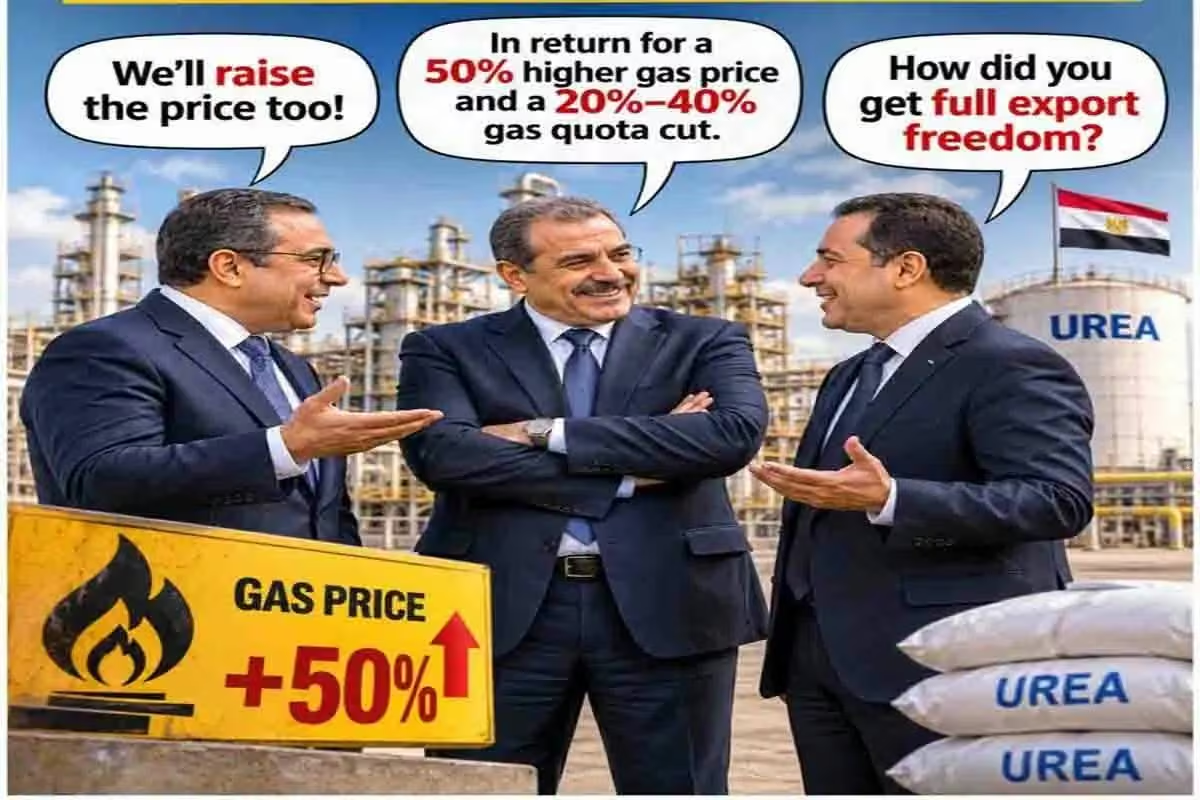
Egyptian fertilizer manufacturers have secured a 45-day window of export flexibility, though shipments will incur higher costs. According to Asharq Bloomberg, gas prices are set to increase by 50 percent, rising from $8.50 to $12.75 per MMBtu, effective Monday, November 16, and lasting for 45 days until early January 2027. Under the new arrangement, companies are permitted to export their entire production output without being required to fulfill subsidized quotas for the Ministry of Agriculture.
However, gas supply allocations will still be reduced by 20 percent to 40 percent. The agreement eases export obligations but does not resolve the underlying raw material constraints. The report notes that plants can operate at full capacity, yet it does not explain how this is achievable given the ongoing supply restrictions. The deal was reached following a meeting on Thursday with Industry Minister Khaled Hashem, during which producers sought an exemption from subsidized fertilizer delivery obligations, citing the ministry’s existing stockpiles.
The Cairo government has sought to prevent plant shutdowns and the failure to meet export commitments, while shifting part of the burden of rising gas procurement costs onto manufacturers, rather than allowing the state to absorb the entire gap between import costs and domestic selling prices.
Agriculture Minister Alaa Farouk told Asharq Bloomberg that agricultural cooperatives currently hold approximately 400,000 tons of subsidized fertilizer, a stockpile sufficient to meet demand for more than two months. The ministry itself holds over 40% of the total 900,000-ton requirement for the winter season.
Farouk emphasized that the gas supply cuts will not affect the allocation of subsidized fertilizer, and that government-regulated prices and quotas for farmers will remain unchanged. The existing inventory provides manufacturers with the flexibility to redirect their production to foreign markets.
Gas supply to energy-intensive industries has been curtailed by approximately 350 million cubic feet per day, down from a total requirement of 1.06 billion cubic feet. An unnamed government official estimated that this reduction yields savings of $10.7 million per day, or $321 million per month. The state covers the costs associated with imported gas, transportation, and LNG regasification. For certain producers, the effective cost of gas exceeded $9/MMBtu by the end of April 2026, compared with roughly $5.50 in March.
Egyptian fertilizer exports reached $2.53 billion during the January–September 2026 period, marking a 14.2 percent increase from $2.22 billion in the same period of the previous year. Total exports of chemicals and fertilizers amounted to $9.54 billion, up 33.6 percent from $7.14 billion in the corresponding period of 2025.
The reduction in gas supply has raised concerns regarding already contracted shipments. Companies are negotiating to reschedule deliveries without incurring penalties, while importers are reportedly willing to accept volume reductions of 20%–30%.
Saad Abu El-Maati, chairman of Chemical Industries Holding Company and secretary-general of the Arab Fertilizer Association, warned that persistent export constraints could drive buyers to seek alternative suppliers, thereby eroding Egypt’s market share. Although the Cairo government has granted a 45-day export flexibility window, gas supply bottlenecks remain unresolved.
Chnchemicals take
This temporary flexibility offers Egyptian producers a short-term reprieve from domestic quota obligations, but the simultaneous 50 percent gas price hike and supply cuts severely compress margins. The unresolved raw material constraints undermine the viability of full-capacity operations, signaling that structural supply chain risks remain high for global buyers relying on Egyptian exports. Investors should view this as a stopgap measure that does not eliminate the fundamental volatility in production costs and availability.
Frequently asked questions
What export flexibility have Egyptian fertilizer producers been granted under the new 45-day arrangement?
Producers are permitted to export their entire production output without fulfilling subsidized quotas for the Ministry of Agriculture. This 45-day window is designed to prevent plant shutdowns and ensure export commitments are met despite higher gas costs.
How will the 50 percent increase in gas prices affect Egyptian fertilizer production costs?
Gas prices will rise from $8.50 to $12.75 per MMBtu, significantly increasing production costs for manufacturers. This price hike is effective for 45 days, starting November 16, and will impact the profitability of export shipments.
What are the potential long-term risks for Egyptian fertilizer exporters if gas supply constraints persist?
Persistent export constraints and gas supply bottlenecks could drive buyers to seek alternative suppliers, eroding Egypt's market share. Industry leaders warn that unresolved raw material constraints threaten the sustainability of the sector's global competitiveness.