South Korea: Hyosung Chemical Opting for Private Placement Bonds Over 7% Commercial Paper Amid Rising Interest Rate Burden
Key facts
- Hyosung Chemical issued 10 billion won in six-month private placement bonds with a 6.7% coupon rate on the 5th for business operations
- The company has executed three six-month private corporate bond deals this year, raising a total of 680 billion won in 2026
- Hyosung Chemical did not exercise call options on hybrid capital securities issued in 2024, resulting in a step-up spread that raised the annual interest rate to 11.8%
- First-half cumulative revenue increased 23 percent year-on-year to 1.4583 trillion won, driven by improved profitability in polypropylene and polyketone segments
- Operating profit swung to a surplus of 171.0 billion won in the first half, despite the rising interest rate burden on debt instruments
Blog
Securities 4,799 articles
6-month 10 billion won issuance... Total 680 billion won raised this year
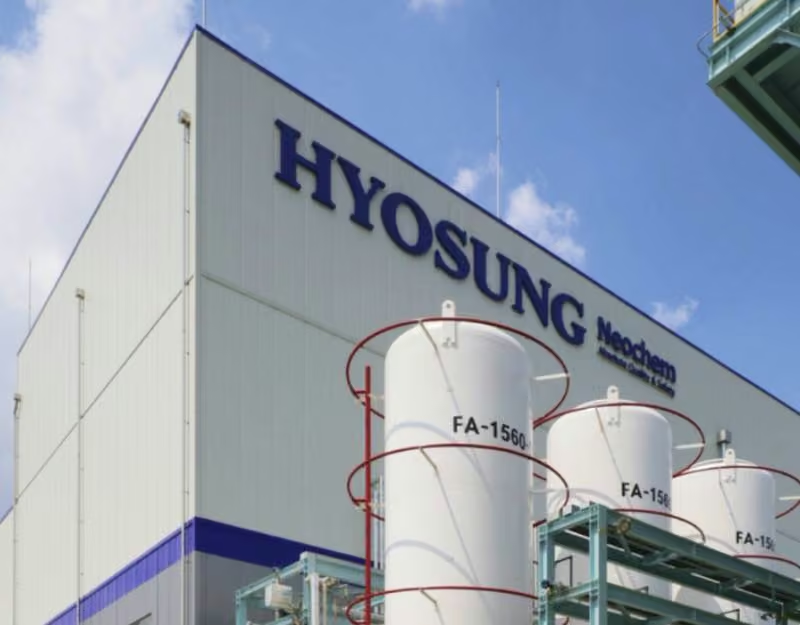
A view of a factory producing NF3 (nitrogen trifluoride), a specialty gas used to clean contaminants in semiconductor manufacturing processes. (Provided by Hyosung Chemical)
Hyosung Chemical has accessed the private placement bond market for the third time this year, with all issuances being short-term instruments with a six-month maturity. Analysts suggest the company is seeking to secure operating funds through the corporate bond market, which carries a lower interest rate burden, as commercial paper (CP) rates have risen above corporate bond yields.
Details of Hyosung Chemical's private placement bond issuances in 2026. (Graphic by Jang So-young, Reporter)
According to investment banking (IB) industry sources on the 16th, Hyosung Chemical issued 10 billion won in six-month private placement bonds with a coupon rate of 6.7% on the 5th. The proceeds are intended for business operations.
This issuance marks the third six-month private corporate bond deal executed by the company this year. On September 30, Hyosung Chemical issued 500 billion won in six-month private placement bonds to raise operating funds. It followed up with an 80 billion won six-month private placement bond issuance on October 30. In total, the company has placed 680 billion won in such instruments this year. The interest rates for the previous two issuances were both 6.75%.
The decision to turn to the corporate bond market instead of the short-term financial market is interpreted as a response to the burden of financing costs. While short-term funds with maturities of around six months are typically raised through CP, issuing private placement bonds allows for a lower interest rate, according to industry explanations. A Hyosung Chemical official stated, "We issued the bonds to lower our financing costs," adding, "We issued the six-month private placement bonds at a lower rate than the 3-month CP issuance rate we had previously used."
Hyosung Chemical has historically borne relatively high financing costs even within its credit rating tier. The company's CP credit rating is A3. The interest rate on the one-month CP issued by Hyosung Chemical in April was approximately 7.2%. The rate on the four-month electronic short-term commercial paper issued in September also approached 6.6%. This level exceeds the average A3-rated CP rate of 6.06% for this year, meaning the company has borne interest rates up to 1.14 percentage points higher than the market average.
The company cited the ongoing structural issues in the petrochemical industry as a factor increasing its financing burden. The petrochemical sector continues to face oversupply of polypropylene (PP) due to large-scale capacity expansions in China. Although spreads have improved since the start of the year, the sustainability of this improvement remains uncertain.
The short-term funding burden on Hyosung Chemical is assessed as being at a heavy level. During the same period, the debt-to-equity ratio stood at 193.1%, and the reliance on total borrowings was 52.1%. Free cash flow (FCF) also showed a net outflow of 19.8 billion won as of the end of the first half of this year. While cash and cash equivalents on a consolidated basis as of the end of June this year amounted to 85.1 billion won, short-term borrowings reached 1.202 trillion won. This is interpreted as indicating that the company's held cash is insufficient to cover its short-term debt obligations.
The interest rate pressure from previously issued hybrid capital securities has also intensified. Hyosung Chemical did not exercise its call option on the hybrid capital securities issued in February and September 2024, two years after issuance. It is understood that the company decided not to exercise the call option after considering its financial condition and other factors. As a result, the step-up spread was applied, expanding the annual interest rate from 8.3% to 11.8%.
However, the improvement in performance observed since the beginning of this year is cited as a positive factor for future cash flow. With the performance of high-value-added businesses such as polypropylene (PP) and polyketone (POK) improving, cumulative revenue for the first half of this year increased by 23% year-on-year to 1.4583 trillion won. Operating profit turned positive at 171 billion won, a reversal from the loss recorded in the same period last year. Net profit for the period was 138.4 billion won, a decrease from 476.5 billion won in the same period last year, reflecting the impact of the sale of certain business units.
Chnchemicals take
Chemical producers are increasingly shifting toward private placement bonds to mitigate rising commercial paper costs, a trend that signals tighter liquidity constraints across the sector. This strategic pivot reduces immediate cash flow pressure but increases long-term refinancing risks, as higher coupon rates on hybrid securities erode margins. Investors should monitor how these elevated financing costs impact the competitive positioning of specialty chemical manufacturers in global supply chains.
Frequently asked questions
Why did Hyosung Chemical choose private placement bonds over commercial paper for its recent 10 billion won issuance?
Hyosung Chemical opted for private placement bonds because commercial paper rates have risen above corporate bond yields. This strategy allows the company to secure operating funds with a lower interest rate burden compared to the current CP market conditions.
What was the coupon rate and maturity of the 10 billion won private placement bonds issued by Hyosung Chemical?
The bonds were issued with a coupon rate of 6.7% and a six-month maturity. The proceeds from this issuance are intended for general business operations, continuing a pattern of short-term debt instruments used by the company this year.
How did improving profitability in polypropylene and polyketone affect Hyosung Chemical's first-half financial results?
Improved profitability in polypropylene and polyketone boosted first-half cumulative revenue by 23 percent year-on-year to 1.4583 trillion won. This performance also swung the company's operating profit to a surplus of 171.0 billion won, supporting its financial stability.