South Korea: S-Oil's Shahin Project Commercialization Countdown... 'Production Increase Risk' on the Test Bench
Key facts
- S-Oil plans to complete the Shahin Project in June and start commercial operations in early next year
- The Shahin Project will produce 1.8 million tons of ethylene annually, a key petrochemical feedstock
- South Korea's petrochemical industry is facing a severe supply surplus driven by aggressive plant expansions in China
- Major domestic firms like Lotte Chemical and LG Chem are lowering operating rates to manage the market glut
- S-Oil is the only major domestic player signaling a massive capacity expansion while others cut production
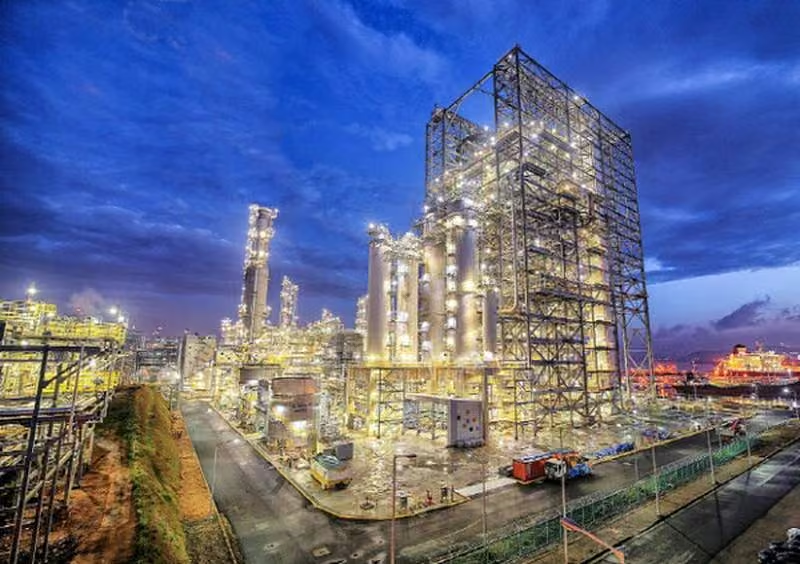
S-OIL, South Korea's largest petrochemical complex, is on the verge of completing its Shahin Project in June this year, with commercial operations expected to commence in early next year. The company aims to transcend the limitations of its traditional refining business and establish itself as a global integrated chemical enterprise. However, the market environment remains challenging. While the domestic petrochemical industry is grappling with severe supply gluts and discussing drastic production cuts, S-OIL stands alone in signaling a massive capacity expansion, placing the company in a strategic dilemma.
The core of the Shahin Project involves the production of 1.8 million tons of ethylene annually, a fundamental feedstock for petrochemical products. The primary concern is that the current petrochemical market is experiencing its worst-ever supply surplus, driven by aggressive plant expansions in China.
Major domestic chemical firms, including Lotte Chemical, LG Chem, SK Geo Centric, and Yecheon NCC, have initiated survival-oriented structural adjustments. These companies are either lowering plant operating rates or pursuing equipment efficiency improvements. In contrast to these competitors tightening their belts and shifting toward production cuts, S-OIL is on the brink of a large-scale capacity increase, drawing divided attention from the market.
Despite these headwinds, S-OIL maintains a steadfast course. The company calculates that it can secure overwhelming cost competitiveness through the "TC2C" process, a technology that directly converts crude oil into petrochemical feedstocks, which it is the first in the world to commercialize. This strategy is further underpinned by the robust capital strength and global sales network of its largest shareholder, Saudi Arabia's Aramco, indicating a determination to confront the sluggish industry conditions head-on.
◆ The Reality Behind a 9 Trillion Won Gamble… Uncertain Profitability
S-Oil has poured 9.258 trillion won into the Shahin project. The scale of the investment has generated high expectations, but it has also brought a significant burden of risk. While the company projects confidence by highlighting the robust capital base of its major shareholder, Saudi Aramco, substantial operational risks remain largely out of public view.
To see the project through to completion, the company must secure the working capital required for initial operations and manage the repayment of massive debt accumulated to date, along with the associated heavy interest costs. A sense of urgency is growing over the possibility that if the ethylene spread—the margin calculated by subtracting production costs from selling prices—falls below the break-even point when the plant is scheduled to start operations in early next year, an astronomical amount of cash could be lost.
Criticism is also spreading over S-Oil’s decision to increase production, which runs counter to the industry-wide moves to cut output to address oversupply. The entire refining and petrochemical sector is currently fighting for survival, pushing for government-led production cuts and plant shutdowns. However, S-Oil’s unilateral push to ramp up output by 1.8 million tons annually risks drawing accusations that it is disrupting the order of the domestic industrial ecosystem.
The industry’s critical view that the company is seeking to capture windfall profits in a market where competitors have reduced supply through aggressive restructuring is placing a considerable burden on its external reputation.
◆ S-Oil: "Not Indiscriminate Supply... Direct Ethylene Delivery"
The company’s position diverges from concerns regarding production cut risks and potential misalignment with government policies surrounding the Shahin Project. S-Oil argues that the project should not be viewed solely through the lens of simple production volume adjustments. Instead, it advocates for a multifaceted approach that leverages high-efficiency new capital investment to enhance supply chain stability and boost overall industrial competitiveness.
An S-Oil official stated, "This project is not merely about increasing production volumes. It must be understood as a generational transition process that replaces aging facilities and elevates the competitiveness of the entire industry through high-efficiency new capital investment."
The official further emphasized that the majority of ethylene produced under the Shahin Project will be supplied directly via pipeline networks to S-Oil’s own polyethylene manufacturing operations and neighboring petrochemical companies within the Ulsan and Onsan industrial complexes. Consequently, the company asserts that the project is far removed from the indiscriminate oversupply fears circulating in the market.
◆ "Ruling Out Aramco Support…Overcoming Challenges Through In-House Capabilities"
Addressing market speculation that its parent company, Aramco, would inject capital should losses materialize, the company firmly stated that the prospect of external financial support is nonexistent, citing its history of self-sufficiency. Saudi Aramco itself faces constrained liquidity due to heavy investment commitments in domestic mega-projects such as NEOM, reducing its capacity to provide substantial financial backstopping. Should significant operating losses emerge during the initial operational phase, the company would face considerable difficulty in mitigating the backlash from shareholders who have historically relied on high dividend yields.
An S-Oil representative emphasized, "We have maintained the stability of our crude oil supply chain based on a robust trust relationship with our major shareholder, Aramco." The representative added, "Given that the Shahin Project encompasses a portfolio spanning refining, petrochemicals, and lubricants, any underperformance in a specific segment must be balanced and overcome through the strength of our other business units and internal operational capabilities."
As the petrochemical industry navigates an unprecedented downturn, the Shahin Project stands at a critical juncture: it may serve as a turning point that converts crisis into opportunity, or it could become a burden amid a wave of oversupply. Industry attention is now focused on whether S-Oil’s advanced cost-reduction technologies and resilient supply chain strategies will successfully allay market concerns and ensure the project’s stable and successful launch.
Chnchemicals take
S-Oil's expansion strategy creates significant friction within the global chemical supply chain, as it increases output while competitors reduce capacity to address oversupply. This divergence risks destabilizing regional pricing structures and intensifying competition for buyers, who may face short-term price volatility despite the long-term benefit of increased feedstock availability. The success of this move depends entirely on S-Oil's ability to maintain cost advantages in a market currently defined by severe structural imbalances.
Frequently asked questions
When is S-Oil expected to commence commercial operations for its new Shahin Project?
Commercial operations for the Shahin Project are expected to commence in early next year. The project is currently on the verge of completing its construction phase in June this year.
What is the annual ethylene production capacity of S-Oil's Shahin Project?
The Shahin Project is designed to produce 1.8 million tons of ethylene annually. This feedstock is intended to support S-Oil's transition into a global integrated chemical enterprise.
How does S-Oil's capacity expansion contrast with the current actions of other Korean petrochemical firms?
S-Oil is expanding capacity while other major domestic firms are lowering operating rates or pursuing efficiency improvements. The industry is currently grappling with severe supply gluts and discussing drastic production cuts.