Sulfuric Acid
Key facts
- Longzhong 98% sulfuric acid price index fell to 1,318 yuan per ton, a 4.49% week-on-week decline
- Sulfuric acid operating rate dropped by 0.88 percentage points to 63.37% this week
- Phosphate fertilizer off-season and falling sulfur prices weakened the cost floor for acid producers
- Regional maintenance schedules in Shandong and Jiangxi caused significant price differentiation across markets
- Three policy meetings in November are shaping the framework for 2027 export and pricing negotiations
The dominant theme in this week’s sulfuric acid market was not a supply shortage or a collapse in demand, but rather a downward shift in price centers driven by falling production costs and a mismatch in regional supply schedules. The Longzhong 98% sulfuric acid price index fell to 1,318 yuan per ton, a week-on-week decline of 4.49%, while the operating rate dropped by 0.88 percentage points to 63.37%. The off-season for phosphate fertilizers weighed on the baseline of demand, and the retreat of sulfur prices from their highs weakened the cost floor. Meanwhile, divergent schedules for maintenance and restarts in provinces such as Shandong and Jiangxi pushed regional differentiation to the forefront, making it a more critical factor than a uniform price trend. Crucially, three policy meetings were held in November, and the framework for exports and pricing in 2027 is entering a period of negotiation. While short-term price direction is constrained by current supply and demand, medium-term variables are accumulating on the policy front.
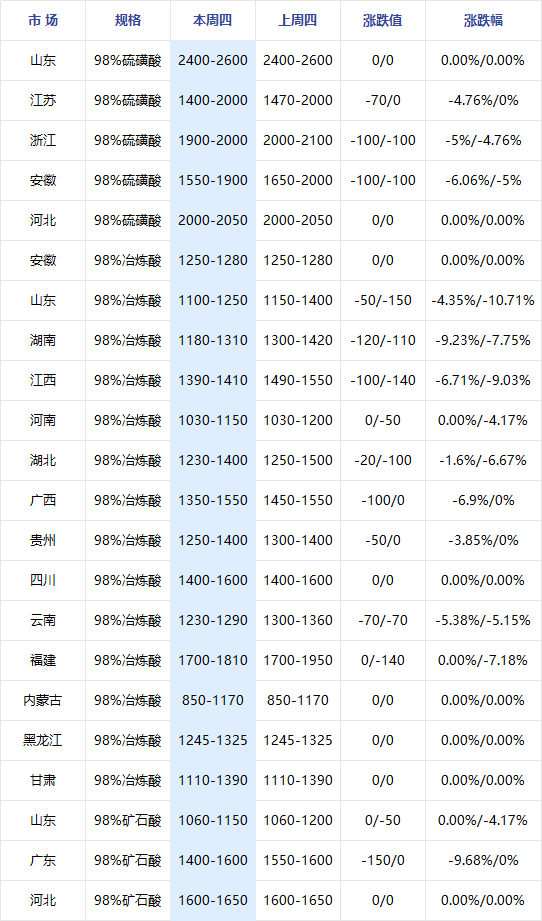
Domestic sulfuric acid prices declined in multiple regions this week. The Longzhong 98% sulfuric acid price index dropped to 1,318 yuan per ton, down 4.49% from the previous week. The delivered price for 98% smelter acid in Hubei ranged from 1,230 to 1,400 yuan per ton, while in Yunnan it stood at 1,230 to 1,290 yuan per ton, a decline of over 5% from the prior week. The data indicates a broad-based downturn, but the drivers of the price drops varied by region. In Shandong, the issue is the imminent return of supply. As units that had been under maintenance resumed operations, regional supply increased. Although some acid producers in the Jiaodong area attempted to hold prices firm, downstream chemical buyers maintained only essential demand, and end-users focused on clearing existing inventories, limiting the potential for a rebound. With the restart of two major acid producers in Jiaodong scheduled for next week, supply pressure is expected to become even more pronounced. In Yunnan and Hunan, the price declines were primarily a result of sluggish fertilizer demand, with major acid plants cutting prices by 70 to 140 yuan per ton this week. Price reductions in Hunan, Jiangxi, and Fujian were largely passive follow-throughs to declines in surrounding markets. Hebei was one of the few regions with tight supply, as ore-based acid producers in Qinhuangdao and Handan remained under maintenance, leading to a shortage of local commercial acid. However, the continuous inflow of low-priced acid from Hubei and Inner Mongolia kept local high prices firmly suppressed. Even in regions with genuine supply support, prices did not command a corresponding premium.
This regional divergence stems from a shift in pricing power from a narrative centered on supply-side maintenance to one driven by the ability of demand-side essential needs to absorb supply and the scope for regional arbitrage. When low-priced goods from surrounding areas can flow in freely, the price support from local maintenance is significantly discounted. When both phosphate fertilizer and chemical essential demand are absent, competitive price cuts among acid producers replace coordinated efforts to hold prices.
The sulfuric acid operating rate stood at 63.37% this week, down 0.88 percentage points from the previous week. On the surface, the contraction on the supply side should provide a floor for prices. However, the price-supporting effect of this round of maintenance-related reductions was noticeably weaker than in previous years, for two reasons.
First, the buffer of existing inventories remains. Sulfuric acid stocks accumulated earlier have not been fully digested, and some acid producers, even while their units are under maintenance, do not face tight spot supply. For instance, major acid plants in coastal Guangxi and southern Fujian are still in maintenance, but the positive impact of this maintenance has been clearly offset by existing inventories and inflows from surrounding regions, while downstream buyers have become more aggressive in pressing prices down. The maintenance did not translate into a shortage, but rather into inventory accumulation after failed attempts to hold prices. Second, the pace of restarts is altering regional supply expectations. Next week, smelter and ore-based acid producers in Shandong have plans to resume operations, suggesting a potential local supply increase. While major acid plants in Jiangxi have maintenance plans, their impact on the national total is limited. The pattern of "limited change in total supply, with regional gains and losses" means that a simple decline in the operating rate is no longer sufficient to justify a bullish outlook.
The structural composition of sulfuric acid demand dictates the current market's subdued trajectory. Direct consumption for phosphate fertilizers and compound phosphorus fertilizers accounts for approximately 50% of total sulfuric acid demand, forming the industry's foundational base. Chemical applications, including titanium dioxide, caprolactam, and hydrofluoric acid, collectively represent roughly 28% to 31% of demand. Neither sector has generated incremental demand this week.
On the fertilizer front, capacity utilization for monoammonium phosphate stands at 34.68%, while diammonium phosphate utilization is at 37.03%. Although these figures show a slight month-on-month recovery, they remain within historically low ranges. With the autumn fertilization season concluding and winter stockpiling not yet fully initiated, phosphate fertilizer producers are primarily maintaining rigid, essential purchases of sulfuric acid, lacking the incentive for large-scale inventory replenishment. In the chemical sector, titanium dioxide operating rates are at 73.64%, a marginal increase that fails to offset weakness in the downstream coatings and real estate supply chains. Cost support is also eroding, limiting activity to just-in-time consumption. Caprolactam operating rates have declined by 1.80 percentage points month-on-month to 68.99%, further diminishing its marginal pull on sulfuric acid demand.
The core issue on the demand side is not a sudden collapse, but a lack of follow-through. The seasonal dip in phosphate fertilizer demand is not being absorbed by the chemical sector, while the limited essential demand from chemical applications is insufficient to alleviate the sales pressure on acid producers. This structural imbalance is the fundamental reason why sulfuric acid prices have shown little resistance during their recent decline.
The downward shift in sulfuric acid price centers is driven more directly by changes on the cost side than by demand factors. In the sulfur-based production route, sulfur constitutes a significant portion of production costs. After experiencing extreme volatility earlier in the year, sulfur prices have entered a phase of adjustment. Granular sulfur prices at Zhenjiang Port have fallen sharply from their peaks. By the end of October, national port inventories had risen to 1.133 million metric tons, a 20.09% increase from the previous month, significantly cooling expectations of supply tightness. Domestic sulfur production in October was approximately 962,000 metric tons, up 7.7% from the previous month, indicating a synchronized release of domestic supply.
The erosion of cost support transmits to sulfuric acid prices through two channels. First, the theoretical cost floor for sulfur-based acid production has lowered, providing both the incentive for higher operating rates and the room for some producers to cut prices. Second, the weakening of cost support itself undermines the market's "bottom-line" expectations. Downstream buyers, adhering to a "buy on rallies, not on dips" mentality, are increasingly inclined to delay purchases, thereby amplifying the downward slope of prices.
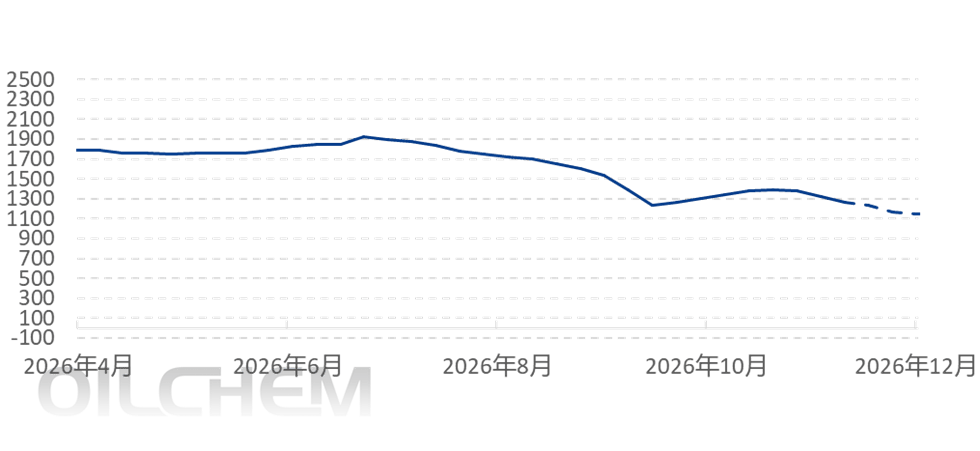
Considering both supply and demand dynamics, the sulfuric acid market is expected to continue its downward trend with weak consolidation over the coming week. The seasonal weakness in phosphate fertilizer demand is likely to persist, while chemical demand remains fragmented and slightly declining overall. Sulfuric acid procurement will remain focused on essential needs, with weak inventory replenishment intent. On the cost side, sulfur and pyrite prices are expected to continue adjusting but are unlikely to return to previous highs, while copper, lead, and zinc ore prices remain stagnant at elevated levels, providing limited cost support. On the supply side, production resumption in Shandong and maintenance shutdowns in Jiangxi will largely offset each other, resulting in limited changes to total supply and no immediate drivers for tightening.
For prices to stabilize or rebound, at least one prerequisite must be met. First, phosphate fertilizer operating rates would need to show a recovery that exceeds seasonal norms, shifting sulfuric acid procurement from small, essential orders to larger inventory replenishment. Second, sulfur prices would need to stop falling and resume an upward trend, establishing a new cost platform to rebuild market confidence in a price floor. Until these conditions are realized, regional price divergence will persist. Regions with maintenance shutdowns and low inventories will see narrower price declines, while areas dependent on external supply inflows and facing weak downstream essential demand will face continued pressure for wider price discounts.
Chnchemicals take
Producers face margin compression as falling sulfur costs remove the previous price floor, while regional maintenance schedules create fragmented trading opportunities. Buyers should exploit local supply gaps during shutdowns, but investors must monitor policy negotiations that will define 2027 export rules. The shift from uniform trends to regional divergence demands granular supply chain visibility to manage inventory risk effectively.
Frequently asked questions
What was the week-on-week change in the Longzhong 98% sulfuric acid price index this week?
The index fell to 1,318 yuan per ton, a 4.49% decline. This drop coincided with a 0.88 percentage point decrease in the operating rate to 63.37%.
How did the operating rate for sulfuric acid production change in the reported period?
The operating rate dropped by 0.88 percentage points to 63.37%. This reduction was driven by maintenance schedules in provinces like Shandong and Jiangxi, creating regional supply imbalances.
Why is regional divergence becoming a more critical factor for sulfuric acid traders than uniform price trends?
Divergent maintenance and restart schedules in provinces such as Shandong and Jiangxi are pushing regional differentiation to the forefront. This makes local supply and inventory levels more important than broad market averages for pricing decisions.