China's Petroleum Coke Imports Rebound in July 2026, Supported by Low-Sulfur Supply and Rising Prices [SMM Analysis]
Key facts
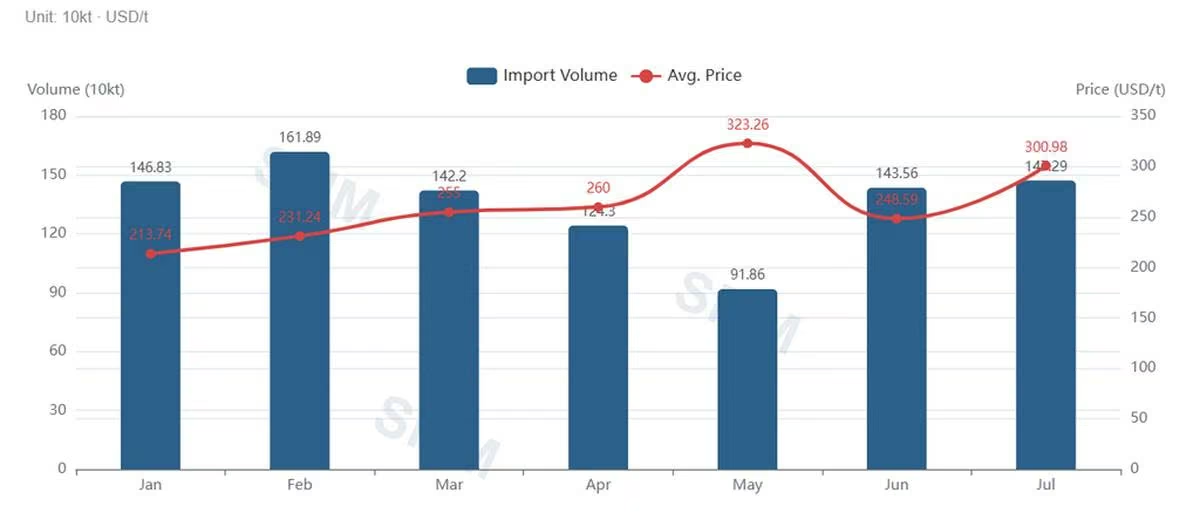
- China's petroleum coke imports in July 2026 reached 1.4729 million metric tons, a 2.60% month-on-month increase
- The average import price for July 2026 was $300.98 per metric ton, up 48.49% year-on-year
- Cumulative petroleum coke imports from January to July 2026 totaled 9.5783 million metric tons, down 1.24% year-on-year
- July import volumes recovered 60.5% from the May low of 918,600 metric tons, returning to normal ranges
- No petroleum coke arrived from Trinidad and Tobago or Colombia in July 2026, shifting cargo flows away from the Caribbean
Customs data indicate that China's total petroleum coke imports in July 2026 reached 1.4729 million metric tons, marking a 2.60% month-on-month increase and a 5.02% year-on-year rise. The average import price for the month stood at $300.98 per metric ton, up 21.08% from the previous month and surging 48.49% compared to the same period last year. From January through July, cumulative petroleum coke imports totaled 9.5783 million metric tons, representing a 1.24% year-on-year decline.
On the import volume front, July continued the month-on-month recovery trend that began in June, keeping volumes above the 1.4 million metric ton threshold for the second consecutive month. Compared to the interim low of 918,600 metric tons recorded in May, July's volume represented a recovery of 555,700 metric tons, or a 60.5% increase, indicating that import rates had returned to normal ranges starting in June.
Regarding average import prices, the July figure of $300.98 per metric ton exceeded the first-half average of $247.22 per metric ton by 21.75%. This premium was primarily driven by a higher share of low-sulfur petroleum coke in imports and constraints on the arrival of cheap, high-sulfur cargo from the Middle East.
By source, July imports were highly concentrated, with the United States, Russia, and Brazil emerging as the top three suppliers. Import volumes from these countries were 399,000 metric tons, 323,100 metric tons, and 181,300 metric tons, respectively, accounting for 27.09%, 21.94%, and 12.31% of total monthly imports. The source mix in July shifted significantly from June, reflecting a pattern of declining shares from the U.S. and Russia, low-sulfur supply filling the gap, and supply disruptions from the Middle East.
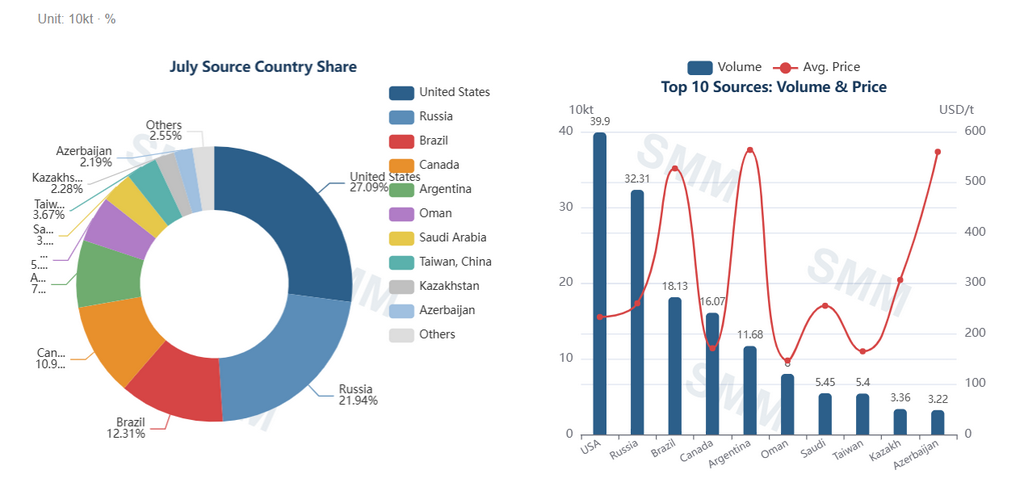
The United States and Russia remain the top two suppliers, but their combined share has fallen to 49% in June. The joint share of the U.S. and Russia stood at 64% before dropping to 49.03% in July. U.S. imports declined from 541,800 metric tons to 399,000 metric tons (a 26.3% month-on-month decrease), while Russian imports fell from 375,100 metric tons to 323,100 metric tons (a 13.9% month-on-month decrease). The reduction in Gulf U.S. cargo is linked to higher overseas market prices and cautious ordering by traders.
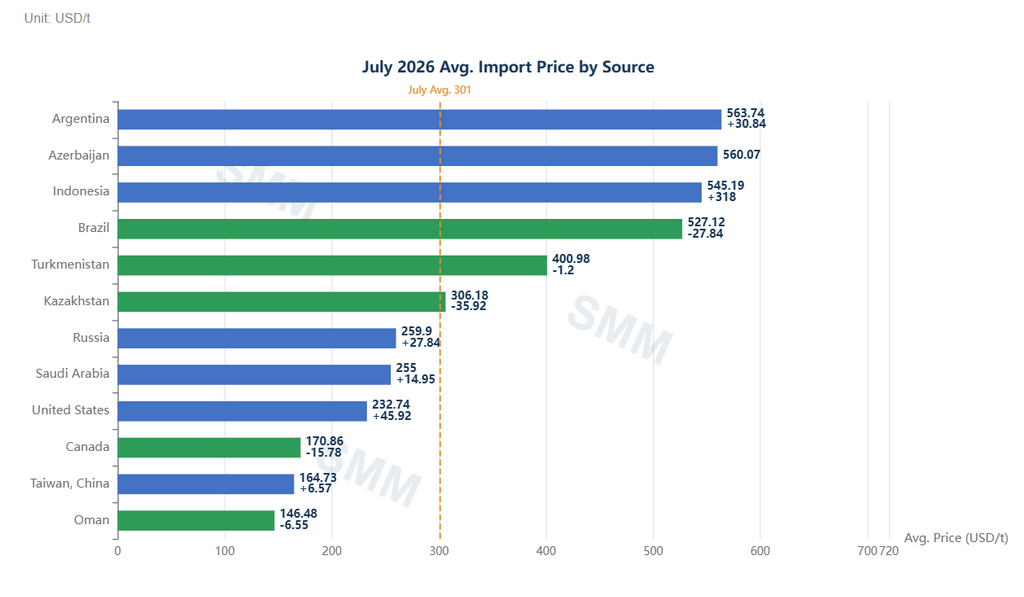
Brazil’s low-sulfur petroleum coke has surged rapidly, becoming the third-largest source. Brazil’s petroleum coke imports in July reached 181,300 metric tons, up 65.1% from 109,800 metric tons in June, with an average price of $527.12 per metric ton. The majority of the imports consisted of high-quality, low-sulfur sponge coke, which was primarily shipped to the prebaked anode industry.
Canada and Argentina have recently entered the top tier. Canada recorded a volume of 160,700 metric tons (average price $170.86 per metric ton), with most of the flow directed to prebaked anodes. Argentina recorded a volume of 116,800 metric tons (average price $563.74 per metric ton) of high-quality, low-sulfur petroleum coke, which was primarily shipped to the prebaked anode and anode materials sectors.
Middle East supply has been uneven. Oman resumed arrivals at 80,000 metric tons after a two-month hiatus. Saudi Arabia’s volume stood at 54,500 metric tons, unchanged from June, but Kuwait and the United Arab Emirates still had no cargo arrivals. The impact of shipping disruptions through the Strait of Hormuz has not fully dissipated.
There were no arrivals from Trinidad and Tobago or Colombia. In June, volumes from these two countries were 99,500 metric tons and 55,800 metric tons, respectively. In July, they disappeared from the list of origin countries, reflecting a shift in cargo flows from the Caribbean region.
The July average import price of $300.98 per metric ton surged 21.07% month-on-month, also exceeding the first-half average of $247.22 per metric ton by 21.75%. Two primary factors drove this increase. First, a higher share of low-sulfur petroleum coke imports pushed the overall average upward, as port arrivals of premium low-sulfur resources from Brazil ($527.12 per metric ton), Argentina ($563.74 per metric ton), and Azerbaijan ($560.07 per metric ton) rose significantly. Second, port arrivals of low-priced, high-sulfur cargo from the Middle East were constrained, weakening the dilutive effect of high-sulfur resources on the average price.
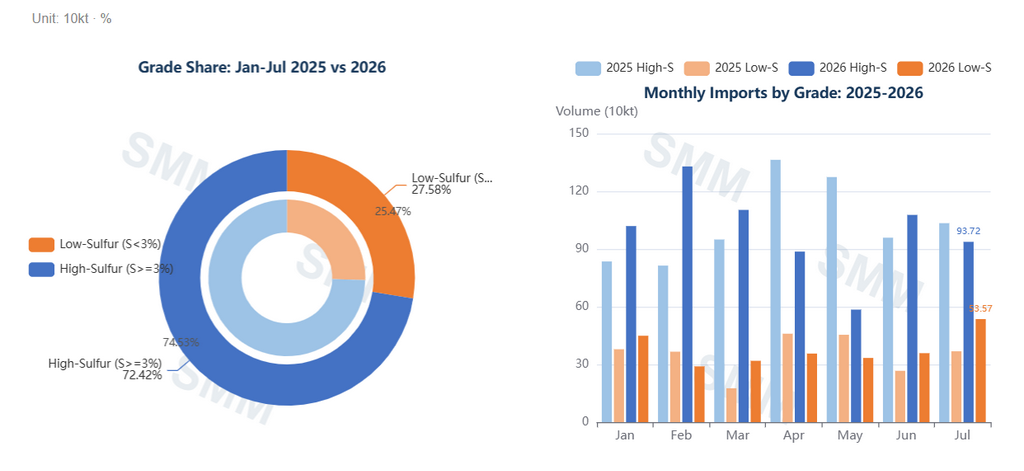
From a product composition perspective, cumulative imports of low-sulfur petroleum coke (sulfur content <3%) from January to July 2026 totaled 2.6422 million metric tons, accounting for 27.6% of total imports. This represents an increase of approximately 2.1 percentage points from the 25.5% share recorded during the same period in 2025. High-sulfur petroleum coke (other uncalcined petroleum coke) accounted for 72.4% of the total, with cumulative volumes reaching 6.9371 million metric tons.
In July alone, imports of low-sulfur petroleum coke (sulfur content <3%) surged to 535,700 metric tons, marking a new high for the year. This figure represented a 49.3% month-on-month increase from June and constituted 36.4% of total imports for that month. The share jumped sharply by 10.1 percentage points from the 26.3% recorded in July 2025.
The sustained rise in the share of low-sulfur petroleum coke (sulfur content <3%) reflects strong demand from the pre-baked anode sector and downstream anode material manufacturers for high-quality, low-sulfur products. Conversely, the share of high-sulfur petroleum coke imports has gradually declined due to constrained supply from the Middle East and the impact of substitution effects.
China's petroleum coke imports continued their recovery in July 2026, maintaining a level above 1.4 million metric tons for the second consecutive month. Monthly imports of low-sulfur petroleum coke set a new year-to-date record, while the structure of imported supply improved significantly. Demand-side support remained robust: rising orders in the downstream anode materials market drove strong demand for low-sulfur petroleum coke, which has seen sustained growth. Demand in the carbon market used for aluminum production remained stable, and China's overall consumption of petroleum coke continued to improve.
On the supply side, the restricted arrival of low-priced, high-sulfur cargo from the Middle East, combined with a higher share of low-sulfur petroleum coke imports, caused the average monthly import price to surge sharply on a month-on-month basis. Following the completion of concentrated maintenance at domestic refineries in the second quarter, operating rates gradually recovered in August, and the growth in domestic petroleum coke supply offset some of the imported volume.
Looking ahead, with strong downstream demand providing support in China, total imports are expected to remain elevated, and the share of low-sulfur petroleum coke imports may continue to rise. On the price front, tight supply of high-quality, low-sulfur products outside China is likely to keep average import prices at elevated levels in the short term.
Chnchemicals take
The sharp rise in import costs signals that global supply chains are tightening for high-quality feedstocks, forcing Chinese refiners to pay a significant premium. This price escalation, driven by the scarcity of low-sulfur products, will likely compress margins for downstream chemical producers who rely on these inputs. Traders should anticipate continued volatility as shipping disruptions and regional supply gaps persist, making inventory management critical for maintaining operational stability.
Frequently asked questions
What were the volume and price trends for China's petroleum coke imports in July 2026?
Imports reached 1.4729 million metric tons, up 2.60% month-on-month, while the average price hit $300.98 per metric ton. This price increase of 48.49% year-on-year was driven by a higher share of low-sulfur petroleum coke in the import mix.
What factors are expected to influence petroleum coke import prices in the short term?
Tight supply of high-quality, low-sulfur products outside China is likely to keep average import prices at elevated levels. Strong downstream demand in China continues to support import volumes, while shipping disruptions through the Strait of Hormuz remain a factor.