Ukraine strikes major Russian petrochemical complex, record number of UAVs intercepted
Key facts
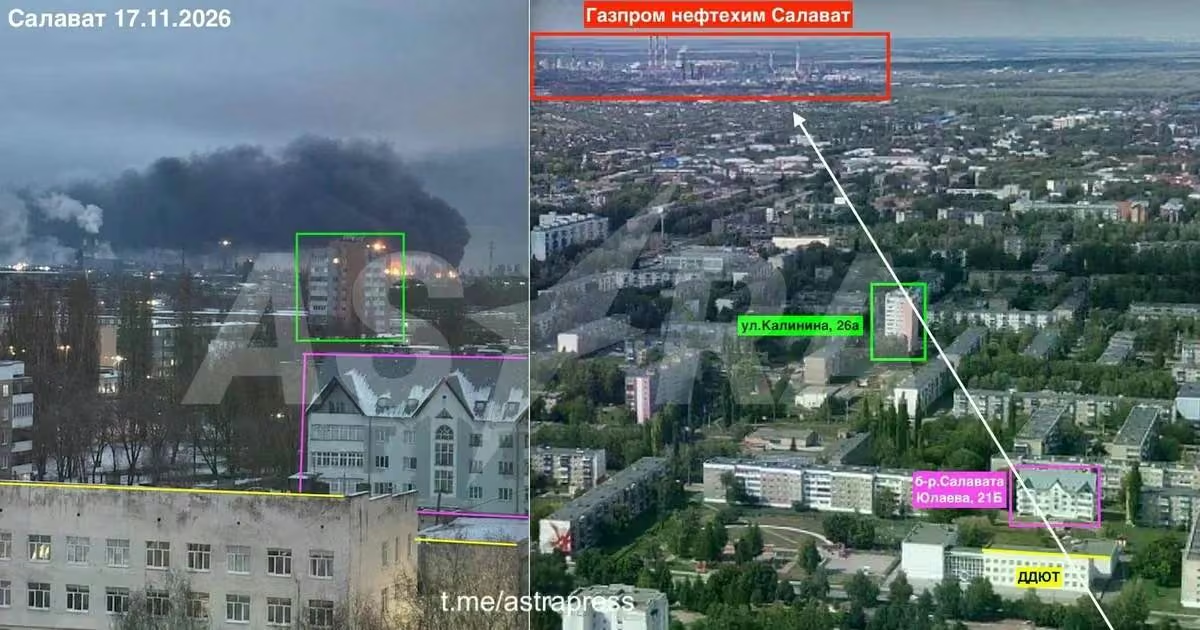
- Ukrainian drones attacked the Gazprom Neftekhim Salavat petrochemical complex in Bashkortostan on November 16 and 17, causing a significant fire
- Moscow reported intercepting 1,441 Ukrainian drones overnight, with approximately 800 targeted at the capital
- Russian officials stated that air defense units and fire brigades downed more than 50 drones in the Bashkortostan region
- Independent media outlet Astra verified videos suggesting the strike hit the Gazprom Neftekhim Salavat facility, a major Russian plant
Ukrainian drone strikes have penetrated deeper into Russian territory, targeting a major petrochemical complex, while Moscow claims to have intercepted a record number of unmanned aerial vehicles in a single night.
Ukrainian drones were reported to have attacked the Gazprom Neftekhim Salavat petrochemical complex in the Russian Federation’s Bashkortostan Republic during the night of November 16 and the early hours of November 17, triggering a significant fire. Concurrently, Moscow stated that its air defense systems intercepted 1,441 Ukrainian drones overnight, with approximately 800 reportedly aimed at the capital.
According to the Bashkortostan Emergency Situations Committee, the drone attacks targeted the city of Salavat and the republic’s capital, Ufa. Russian officials indicated that air defense units, industrial security teams, and mobile fire brigades downed more than 50 drones.
However, videos recorded by local residents and verified by the independent Russian media outlet Astra suggest that the strike may have hit the Gazprom Neftekhim Salavat facility, one of the country’s largest petrochemical plants.
Local residents reported hearing multiple explosions and observing fires in the Salavat industrial zone.
Founded in 1948, Gazprom Neftekhim Salavat operates oil refining and petrochemical facilities that produce gasoline, diesel fuel, aviation fuel, mazut, polyethylene, polystyrene, ammonia, urea, and butyl alcohols.
The facility also supplies fuel to the Russian military, while certain petrochemical products are utilized in the country’s defense industry. Ukraine previously struck the complex on October 8, triggering a fire near the oil refinery.
Substation in Kursk also hit
In a separate development, Ukrainian forces are reported to have struck the Sadovaya electrical substation in Russia's Kursk region on the night of November 16, according to Astra.
The facility supplies power to approximately 400,000 residents and major industrial sites within the city. Constructed in 1965, the substation underwent a significant modernization between 2010 and 2014, which included the installation of digital control systems.
Russian authorities have not officially confirmed the attack or acknowledged any damage to the facility.
Crimea Bridge Remains a Target
The Crimea Bridge was also struck during the night of November 16 into the early hours of November 17, marking the second reported incident at this strategic transportation infrastructure within a 24-hour period.
Footage shared by the Telegram channel Crimean Wind is believed to show one of the bridge’s two arch spans collapsing into the sea. However, the visual evidence and the extent of the damage have not been independently verified.
These developments followed another attack on the bridge on November 16.
Russia claims record number of drones intercepted
The Russian Defense Ministry announced that its air defense systems shot down 1,441 fixed-wing Ukrainian drones overnight across 21 Russian regions, the Crimean Peninsula, and the Black Sea and Sea of Azov.
According to the ministry, the drones were intercepted in multiple locations, including Moscow, Kursk, Rostov, Saratov, Tver, Ulyanovsk, Bashkortostan, and the Krasnodar region.
Moscow Mayor Sergei Sobyanin stated that approximately 800 drones were directed toward the capital between the evening of November 16 and the morning of November 17, with 321 of them intercepted in the areas surrounding the city.
If verified, the figure of 1,441 drones would set a new record for the number of Ukrainian drones Russia claims to have intercepted in a single night since the full-scale conflict between the two nations began.
This number surpasses the 1,336 drones that the Russian Defense Ministry claimed to have intercepted just one day earlier, on November 16, during one of the largest recorded drone attacks in the conflict.
Chnchemicals take
The successful strike on a major Russian petrochemical facility highlights the growing vulnerability of upstream and midstream assets to long-range drone attacks. This development forces chemical producers and traders to reassess supply chain risks, as physical damage to production capacity can disrupt global feedstock availability. The precision of the attack underscores that even deep inland industrial sites are no longer safe from modern military tactics, increasing operational uncertainty for investors in the region.
Frequently asked questions
Which specific petrochemical complex was targeted by Ukrainian drones in Bashkortostan?
The Gazprom Neftekhim Salavat petrochemical complex was targeted by Ukrainian drones. The strike triggered a significant fire at the facility, which is one of Russia's largest petrochemical plants.
How many drones did Moscow claim to have intercepted during the night of the attack?
Moscow stated that its air defense systems intercepted 1,441 Ukrainian drones overnight. Approximately 800 of these drones were reportedly aimed at the capital, Moscow.
What impact does the strike on Gazprom Neftekhim Salavat have on regional petrochemical operations?
The strike triggered a significant fire at the facility, posing a risk to ongoing operations. Local residents reported multiple explosions, and emergency teams were deployed to manage the incident and secure the site.