India: Fertilizer Subsidy to Hit Record Rs 2.76 Lakh Crore in FY27, ICRA Estimates
Key facts
- ICRA forecasts India's fertiliser subsidy outlay will reach Rs 2.76 lakh crore in FY2027, a record high
- The projected FY2027 subsidy exceeds the current Budget allocation of Rs 1.71 lakh crore by Rs 1.05 lakh crore
- Global raw material prices for ammonia, sulphur, and phosphoric acid have spiked due to geopolitical instability in West Asia
- Importing DAP at current international prices results in a loss of approximately Rs 11,432 per tonne for Indian buyers
- ICRA estimates agricultural gross value added growth will decelerate to 0.2% in Q2 FY2027, down from 3.6% in Q1
Credit rating agency ICRA forecasts that India’s fertiliser subsidy outlay will surge to an unprecedented Rs 2.76 lakh crore in fiscal year 2027. This projection, detailed in a November 2026 report, indicates a shortfall of Rs 1.05 lakh crore against the current Budget allocation. The agency attributes the escalating expenditure to a confluence of factors, including soaring raw material prices on global markets, geopolitical instability, and increased natural gas costs.
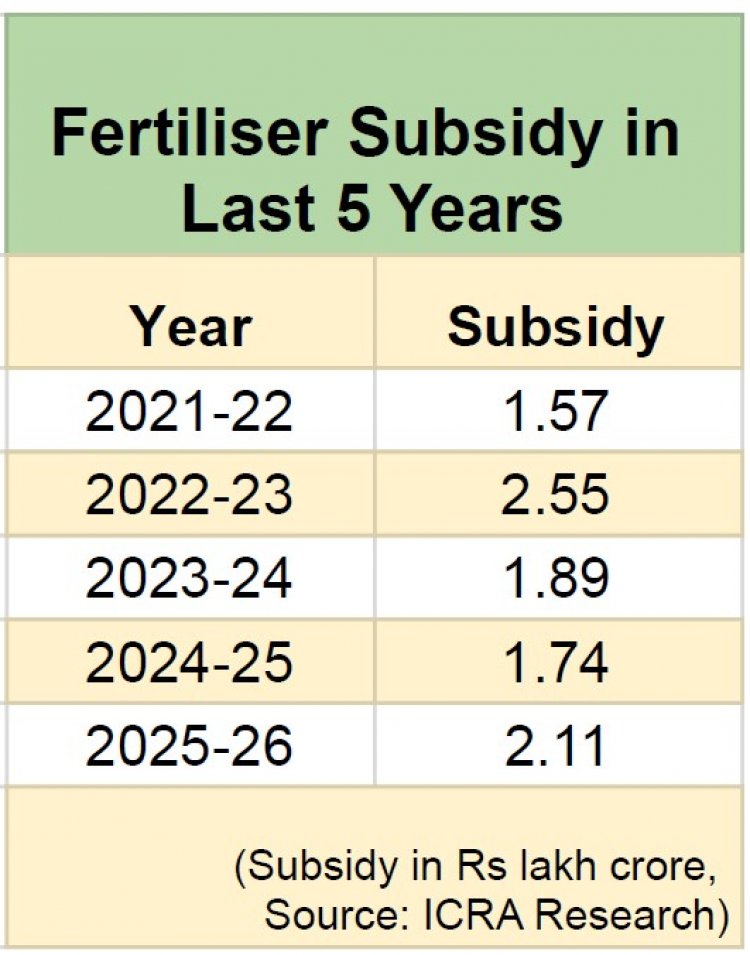
The anticipated requirement significantly outstrips the Rs 1.71 lakh crore provisioned in the Budget. It also surpasses the previous peak of Rs 2.55 lakh crore, which was recorded in FY2023 in the aftermath of the Russia-Ukraine conflict. ICRA anticipates that the government will need to secure additional budgetary allocations during the fiscal year to close this funding gap and guarantee uninterrupted subsidy disbursements to fertiliser manufacturers.
This surge in subsidy costs coincides with a sharp spike in the prices of critical inputs such as ammonia, sulphur, and phosphoric acid. The price escalation has been driven by the geopolitical crisis in West Asia, a region that serves as a major source for fertiliser raw materials.
Government Raises Nutrient-Based Subsidy Rates
In a move to mitigate the financial burden of rising input costs, authorities have significantly hiked Nutrient-Based Subsidy (NBS) rates for the latter half of fiscal year 2027. The subsidy allocated for nitrogen has effectively doubled, surging from Rs 47,320 per tonne in the first half of the fiscal year to Rs 94,210 per tonne. Concurrently, the phosphorus subsidy saw a 25% increase, rising from Rs 52,760 to Rs 66,110 per tonne, while the sulphur subsidy more than tripled, jumping from Rs 3,160 to Rs 10,420 per tonne. The subsidy for potash, however, remains static at Rs 2,380 per tonne.
Additional financial support includes the continuation of a special package offering Rs 3,500 per tonne for diammonium phosphate (DAP). Furthermore, a 20% subsidy is applied to the procurement of sulphur and sulphuric acid, contingent upon floor prices set at $800 and approximately $267 per tonne, respectively.
ICRA projects that these revised subsidy structures will enhance the profitability of manufacturers producing phosphate and potash (P&K) fertilisers, with particular benefits for NPK producers. The agency also anticipates that these measures will offer some relief to farmers by enabling more rational retail pricing for specific NPK grades.
DAP Imports Continue to Remain Unviable
Profitability pressures persist for both DAP imports and domestic production, even with elevated subsidy support. International DAP prices have surged to $930–950 per tonne, driven by Chinese export restrictions and rising costs for ammonia, sulphur, and phosphoric acid. Meanwhile, the retail price of DAP in India has stayed near Rs 27,000 per tonne.
For the second half of FY2027, the subsidy for DAP imports has been raised to Rs 47,368 per tonne, incorporating an additional package of Rs 3,500, compared with Rs 32,787 per tonne in the first half. ICRA estimates that, at current international price levels, imports will still result in a loss of approximately Rs 11,432 per tonne.
The government is anticipated to continue offering extra compensation under the advantage/disadvantage scheme, aiming to help importers and domestic manufacturers reach break-even levels and ensure sufficient DAP supply.
In contrast, Muriate of Potash (MOP) profitability remains relatively robust, at roughly Rs 6,000 per tonne, bolstered by higher retail prices and a strengthening rupee.
Fertiliser Sales Drop 8.2% in First Half
Fertiliser sales contracted by 8.2% year-on-year to 29.9 million tonnes during the April-September period of FY2027, a decline attributed to weak monsoon conditions, reduced sowing activities and inconsistent product availability.
NPK sales experienced the sharpest drop, falling 22.2% to 6 million tonnes, while MOP sales decreased 11.7% to 1 million tonnes. Urea sales slipped 4.1% to 18.5 million tonnes. In contrast, DAP sales remained virtually flat at 4.4 million tonnes, supported by comparatively lower retail prices and improved supply availability relative to previous years. The decline in NPK demand was primarily driven by significant increases in retail prices.
On the supply side, total fertiliser production fell 7% to 23.5 million tonnes in the first half of FY2027. NPK output plunged 36% to 3.8 million tonnes, whereas urea production rose 4% to 15.1 million tonnes. DAP production held steady at 2 million tonnes.
West Asia Disruption Increases Import Costs
Supply chain disruptions in West Asia have compelled Indian producers to pivot their sourcing strategies toward alternative suppliers, including entities in Russia, North Africa, and other global regions. Despite this diversification, procurement expenses remain at elevated levels.
India’s reliance on West Asian suppliers is most acute for ammonia, where 82% of imports originate from the region, and sulphur, with a 78% share. The region also contributes 56% of DAP imports and 38% of urea imports.
Natural gas prices have stayed high at $22–23 per million British thermal units (MMBtu), driving up production costs and, consequently, subsidy requirements. Nevertheless, gas supply to urea manufacturers has improved, reaching 100% of their requirements from approximately 70% earlier in FY2027.
Fertiliser Stocks Comfortable, Agricultural Outlook Weak
Fertiliser inventories remained adequate as of November 11, 2026, despite ongoing supply disruptions, with stock levels for all major products exceeding those recorded a year earlier. Nevertheless, India is projected to continue relying on imports to satisfy incremental demand, particularly for urea, DAP, ammonia and sulphur.
The report also underscores concerns regarding agricultural output. Kharif sowing had reached 111.5 million hectares by October 2, representing a 1% decline from the previous year. Reservoir storage had fallen to 63% of full capacity by November 12, compared with 90% a year earlier and a historical average of 85%. As a result, total rabi sowing was 11.3% lower year-on-year as of November 13, with wheat acreage down 15.3% and pulses down 14.3%.
ICRA estimates that growth in the gross value added for agriculture, forestry and fishing will decelerate to approximately 0.2% in the second quarter of FY2027, compared with 3.6% in the first quarter. The interplay of rising input costs, inadequate rainfall and diminishing reservoir levels could also weigh on agricultural production in the latter half of FY2027.
Chnchemicals take
The projected subsidy shortfall of over Rs 1 lakh crore signals severe fiscal pressure on the Indian government, forcing reliance on mid-year budget revisions to maintain supply chain stability. For chemical traders and producers, the persistent price gap on key inputs like DAP indicates that domestic margins will remain structurally negative without continued state compensation. This financial burden, combined with slowing agricultural growth, suggests that global chemical suppliers should anticipate reduced import volumes from India as the government prioritizes fiscal consolidation over aggressive procurement.
Frequently asked questions
What factors are driving the increase in fertilizer subsidy costs in India for FY27?
The cost increase is driven by soaring raw material prices, geopolitical instability, and higher natural gas costs. These factors have led to a sharp spike in the prices of critical inputs such as ammonia and phosphoric acid.
How will the rising input costs affect the profitability of DAP imports in India?
At current international price levels, DAP imports will result in a loss of approximately Rs 11,432 per tonne. The government is expected to continue offering extra compensation under the advantage/disadvantage scheme to help importers reach break-even levels.