Longzhong Information's Si Bin: Middle East Tensions Drive Sharp Rise in Sulfur Prices
Key facts
- Sulfur prices in China fell by approximately 50% from their earlier peak by November 13, 2025, due to easing supply constraints and weak downstream demand
- Geopolitical tensions in the Middle East previously drove sulfur prices to nearly double their prior levels before the recent sharp market correction occurred
- China Nonferrous Metal Mining Corporation projects total sulfuric acid output for 2025 at approximately 1.0683 million tons, with 30% allocated to internal consumption
- Wet smelting enterprises that purchase external sulfuric acid have seen production costs decrease significantly as sulfur prices dropped from their earlier highs
- Smelting companies producing sulfuric acid as a byproduct face revenue pressure because the recent price decline has reduced the market value of their secondary product
Geopolitical tensions in the Middle East ignited a surge in sulfur prices earlier this year, with values climbing to nearly double their previous levels. However, as of November 13, the market has corrected sharply. Easing supply constraints and limited downstream demand support have driven sulfur prices down by approximately 50% from their peak. This price decline has triggered divergent outcomes across the non-ferrous chemical industry chain.
Interviews with multiple industry participants reveal that the impact of falling sulfur prices varies significantly by business model. Companies that produce sulfuric acid as a byproduct of smelting operations are facing pressure, as weakening market conditions have reduced the selling price of their sulfuric acid, potentially compressing revenue from this secondary product. Conversely, wet smelting enterprises that rely on externally purchased sulfuric acid for leaching processes have benefited from the price drop, experiencing a notable reduction in production costs.
June Peak, Now “Halved”
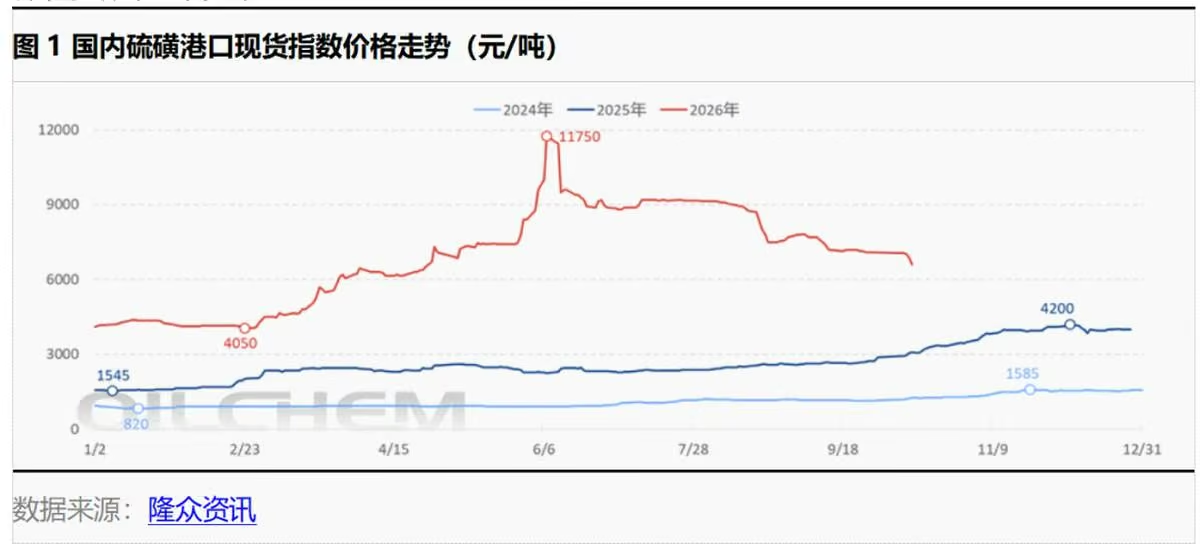
Data from Longzhong Information indicates that sulfur prices have followed a trajectory of initial gains followed by a decline since the start of the year. In June, the domestic port spot price for sulfur reached an annual high of 11,750 yuan per ton, representing a surge of 190% from levels prior to the outbreak of the conflict involving the United States, Israel, and Iran. Subsequently, prices gradually retreated. As of November 13, the domestic port spot price stood at 4,950 yuan per ton, marking a 57.87% drop from the peak.
Sulfur is a byproduct of petroleum refining, natural gas extraction and purification, and coal chemical processes, serving as the core raw material for sulfuric acid production. The sulfuric acid derived from this process is a leaching agent for the wet smelting of non-ferrous metals, while the pyrometallurgical smelting of non-ferrous metals itself generates sulfuric acid as a byproduct.
Si Bin, an analyst at Longzhong Information, stated that the significant surge in sulfur prices in the first half of the year was primarily driven by geopolitical disruptions in the Middle East affecting global supply. The Middle East is a major global producer of sulfur, and the region’s external supply of sulfur resources contracted significantly year-on-year in 2026.
Si Bin noted that following the escalation of geopolitical conflicts from late February to March, navigation in the Strait of Hormuz was obstructed, delaying the export of sulfur from the Middle East and causing a marked decline in domestic imports from the region. To ensure the essential domestic demand for phosphate fertilizers, China implemented sulfur supply guarantee policies to offset the external supply gap, which also reduced domestic reliance on Middle Eastern imports. Furthermore, the sustained rise in sulfur prices subsequently dampened downstream procurement demand.
Si Bin analyzed that as global demand for sulfur weakened overall, overseas sulfur prices continued to fall. However, a significant price inversion currently exists between overseas prices and domestic spot prices. Coupled with just-in-time procurement by long-term contract holders and a small number of end-users, these factors collectively drove a rebound in the domestic sulfur market in November. Nevertheless, the sustainability of this rebound remains uncertain and will depend on the subsequent restocking intentions of domestic merchants.
Sulfuric Acid Producers: Sector Earnings May Retreat
The recent pullback in sulfur prices is exerting a bifurcated impact on non-ferrous smelters, with the specific effect hinging on whether a company acts as a sulfuric acid supplier or a consumer. For firms engaged in pyrometallurgy that generate sulfuric acid as a byproduct and sell it externally, the softening market conditions are compressing their ancillary revenue. Conversely, hydrometallurgical operations that must purchase sulfuric acid for leaching processes are seeing their production costs ease as acid prices decline. Copper smelting serves as a prime example of this divergence, where falling sulfur prices affect pyrometallurgical and hydrometallurgical operators in distinct ways.
China Nonferrous Mining Corporation (CNMC) informed reporters that the company does not procure sulfur in any significant volume, as sulfuric acid is a byproduct of its pyrometallurgical plants. According to the company, total sulfuric acid output in 2025 is projected at approximately 1.0683 million tons. Of this volume, 30% is allocated to internal consumption by its hydrometallurgical subsidiaries, while the remaining 70% is sold to the open market. This byproduct stream has emerged as a primary profit driver for the company’s smelting division in 2025.
It is noteworthy that sulfuric acid markets are exhibiting regional disparities. Demand in Central and Southern Africa remains robust, and local acid prices have not mirrored the sharp domestic correction seen in sulfur prices. Data indicates that in October, the ex-works price for sulfuric acid at the Lualaba copper smelter in the Democratic Republic of the Congo ranged from $890 to $900 per ton, while the price at the Chambishi copper smelter in Zambia stood between $450 and $500 per ton, levels that remain relatively elevated.
CNMC operates as a key sulfuric acid supplier within Zambia. The country’s domestic pyrometallurgical plants possess an annual sulfuric acid production capacity of roughly 800,000 tons, of which CNMC accounts for approximately 250,000 tons. A maintenance shutdown at the Chambishi copper smelter, which lasted from September through mid-October, tightened regional supply and drove local sulfuric acid prices upward from $400 per ton in early September. Although regional sulfur prices softened slightly on a quarter-on-quarter basis in the third quarter, the dominant factor in acid price movements was the supply contraction, which kept prices firm.
Sulfur Consumers: Easing Cost Pressures
For non-ferrous and chemical enterprises that rely on sulfur as a primary feedstock, the recent pullback in prices has translated into lower procurement costs, offering a temporary reprieve. However, the extent of this benefit is constrained by several structural factors.
A representative from China Molybdenum Co., Ltd. (CMOC) told reporters that the decline in sulfur prices helps suppress raw material expenses, which is a positive development for the company’s operations.
Beyond the immediate savings from falling sulfur prices, the company has implemented routine technical measures to control acid consumption, thereby mitigating the impact of price volatility. During the period of elevated sulfur prices in the Democratic Republic of Congo from April to May, the KFM laboratory identified that a pH level of 1.55 yields the optimal balance between copper leaching efficiency and sulfuric acid consumption per ton of ore. Leveraging these experimental findings and the results of a dedicated initiative to reduce acid usage, KFM’s acid consumption per ton of ore in April and May dropped significantly compared to the first quarter. Additionally, CMOC’s China operations have begun recovering sulfur dioxide from flue gas in the roasting process, converting it into 98% industrial sulfuric acid to bolster its internal acid supply.
An official from Xingfa Group noted that lower sulfur prices can reduce the production costs of the company’s fertilizer products. Nevertheless, despite the recent correction, sulfur prices remain at elevated absolute levels, meaning that cost pressures for the enterprise persist.
Previously, it was difficult to pass on the costs of rising sulfur prices to downstream phosphorus fertilizer producers, forcing companies to absorb most of the incremental expenses. To address the sustained high price environment, the company is advancing a project to produce sulfuric acid from phosphogypsum while co-producing cement. Once operational, this facility is expected to further reduce the volume of externally purchased sulfur.
Chnchemicals take
The sharp 50% correction in sulfur prices creates a bifurcated impact across the non-ferrous chemical supply chain, directly benefiting wet smelting operators through reduced input costs while squeezing margins for byproduct producers. This divergence highlights how geopolitical supply shocks can rapidly reverse into structural cost advantages for specific segments, forcing traders to reassess hedging strategies and inventory positions. Investors should monitor how these shifting cost structures influence the competitive dynamics between pyrometallurgical and hydrometallurgical processing methods in the coming quarters.
Frequently asked questions
How much have sulfur prices declined from their peak due to easing supply constraints and limited demand?
Sulfur prices have dropped by approximately 50% from their peak levels. This correction occurred as supply constraints eased and downstream demand support remained limited in the market.
What is the projected total sulfuric acid output for CNMC in 2025, and how is it allocated internally?
CNMC projects total sulfuric acid output of approximately 1.0683 million tons for 2025. Of this volume, 30% is allocated for internal consumption by its hydrometallurgical subsidiaries.
How does the recent decline in sulfur prices affect wet smelting enterprises that purchase sulfuric acid externally?
Wet smelting enterprises have benefited from the price drop, experiencing a notable reduction in production costs. This contrasts with smelting byproduct producers, who face pressure from reduced selling prices for their sulfuric acid.