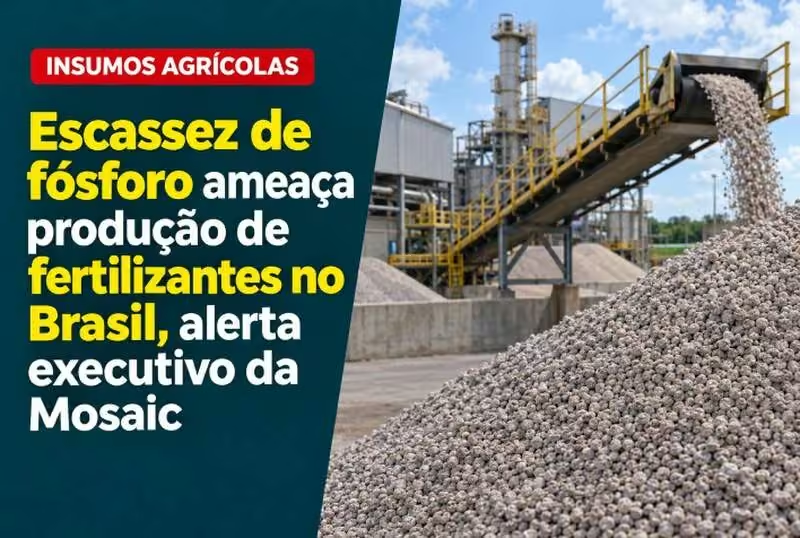
Phosphorus shortage threatens fertilizer production in Brazil, warns Mosaic executive
Key facts
- Mosaic's Brazil manager warned of historically low phosphorus inventories and operational halts in the domestic fertilizer industry
- Sulfur imports to Brazil have dropped by 50%, a key indicator of the severe constraints facing raw material supply chains
- The Persian Gulf region accounts for half of global sulfur exports, 36% of urea exports, and 29% of ammonia exports
- International conflicts in Eastern Europe and the Middle East have disrupted supply chains and undermined phosphate fertilizer production viability
- A study presented in São Paulo highlighted that navigation restrictions in the Persian Gulf heighten market vulnerability to cargo transport disruptions
The industry is forecasting historically low carryover inventories, a situation that, combined with international conflicts and logistical hurdles, is escalating risks to both supply chains and the fertilization of agricultural fields.
Brazil faces an inadequately assessed risk of phosphorus shortages for fertilizer production, according to Eduardo Monteiro, Mosaic’s country manager in the country. The executive noted that the domestic industry is experiencing operational halts and projects the lowest year-end inventory levels in its history, amid ongoing constraints on raw material supply.
Monteiro issued the warning on Thursday, May 5, during the Vozes do Agro event, hosted by Globo Rural and Valor Econômico in São Paulo. At the gathering, industry representatives examined how international conflicts, logistical bottlenecks, and credit difficulties are impacting input availability and influencing decision-making among Brazilian producers.
In Monteiro’s assessment, wars in Eastern Europe and the Middle East have disrupted supply chains and undermined the viability of phosphate fertilizer production.
The executive highlighted a 50% drop in sulfur imports as an indicator of the issue’s severity. He argued that this restriction signals a potential production decline exceeding 50% in sectors affected by the raw material shortage.
The immediate challenge, according to the executive, is to reduce the country's exposure to the shortage and prevent industrial difficulties from translating into even greater constraints on agricultural supply.
Monteiro believes that Brazil is unlikely to achieve self-sufficiency in fertilizers, but he advocates for measures to decrease external dependence.
Among the priorities identified are support for industrial investments, regulatory progress in mineral concessions, and tax changes capable of improving the competitiveness of domestic production.
The executive viewed the National Program for Incentivizing Fertilizer Production (Profert) positively. However, he stated that the bureaucracy involved in accessing credit and the scale of supply issues limit the initiative's capacity to respond in the current scenario.
According to Monteiro, some farmers have decided to reduce fertilizer application this year. He noted that bioinputs have helped partially compensate for the lower fertilization rates, but they are not sufficient to solve the problem.
Mosaic’s representative also highlighted regulatory hurdles surrounding bioinputs, arguing that current frameworks complicate the industry’s ability to launch new products.
These challenges add further pressure to crop planning, which is already strained by high interest rates, financing constraints, and volatile commodity prices.
Arián Krakov, a partner at consulting firm Bain & Company, emphasized the sector’s reliance on international shipping routes. He noted that geopolitical tensions have become more frequent and intense, amplifying their impact on globally interconnected supply chains.
A study presented by the consultancy at the event revealed that the Persian Gulf accounts for half of global sulfur exports, 36% of urea exports, and 29% of ammonia exports.
This concentration heightens the market’s vulnerability to navigation restrictions and disruptions in cargo transport through the region.
Bain & Company’s analysis indicated that the initial closure of the Strait of Hormuz in March 2026 halted the movement of 35% of global urea shipments, 27% of ammonia shipments, and 45% of sulfur shipments.
Krakov noted that the search for alternative supply routes faces significant operational hurdles and high costs. The price of crude oil exceeding $100 per barrel further inflates the expenses associated with raw materials and their transportation.
In the consultant's assessment, restoring normal cargo flows through the strait is critical to alleviating these pressures.
Although projects are underway to expand fertilizer production capacity in various regions by 2030, Krakov believes the projected volumes will be insufficient to replenish the supply disrupted by the conflicts.
Regarding urea, the study presented indicates that even with new industrial units, the projected volume remains 21% below pre-war levels in the Gulf.
The consultant argued that this imbalance requires medium-term planning, as its effects could extend beyond the current and next growing seasons.
According to Bain & Company, Brazil is the third-largest destination for fertilizer exports from the Persian Gulf.
In the 2025/26 season, China, Russia, and Canada were the largest suppliers of components used in NPK formulations. China took the lead, a position held by Russia in the previous nine seasons.
Despite the shift in the sourcing of its purchases, Krakov assessed that the country remains heavily exposed to international shocks.
Among the potential consequences of a prolonged restriction on fertilizer supplies, the study cited productivity losses, a shift toward crops with lower fertilization demands, and rising food prices.
To navigate this landscape, Krakov emphasized the diversification of suppliers, the expansion of strategic stockpiles, and the strategic planning of procurement, which involves negotiating favorable terms when opportunities arise.
On the ground, the measures outlined include the use of soil analyses and precision agriculture tools to guide the application of inputs. The consultant also highlighted the prioritization of fertilization for high-yield, high-value crops as a management alternative, tailored to the specific conditions of each operation.
In the assessment presented at the event, the use of organic inputs was noted as a potential contributor to long-term soil health, although it entails higher costs than chemical fertilizers. A combination of agronomic, financial, and commercial decisions will be necessary to manage supply risks.
Chnchemicals take
The concentration of critical sulfur and ammonia exports in the Persian Gulf creates a single point of failure for global fertilizer supply chains. This geographic dependency means that geopolitical conflicts or logistical bottlenecks in the region can rapidly translate into raw material shortages for producers. Consequently, buyers and traders must anticipate higher price volatility and supply instability, as the current inventory levels offer minimal buffer against further disruptions in international trade routes.
Frequently asked questions
What specific risks does Mosaic's Brazil manager identify for phosphorus fertilizer production in the country?
Mosaic's Brazil manager warns of historically low carryover inventories and operational halts in the domestic industry. These issues are exacerbated by international conflicts and logistical hurdles that disrupt raw material supply chains.
How has the conflict in the Middle East affected sulfur imports for Brazilian fertilizer producers?
Sulfur imports have dropped by 50% due to disruptions in supply chains caused by wars in the Middle East. The Persian Gulf accounts for half of global sulfur exports, making the market vulnerable to navigation restrictions.
What impact do logistical bottlenecks and credit difficulties have on Brazilian agricultural input availability?
Logistical bottlenecks and credit difficulties are impacting input availability and influencing decision-making among Brazilian producers. These factors, combined with rising costs, are driving producers to explore alternative options for fertilization.