South Korea: Q3 Refiners Earned 5.9 Trillion Won While Petrochemicals Post Losses... Outlook: 'Refining Clear, Petrochemicals Cloudy'
Key facts
- Four major South Korean refiners reported a combined operating profit of 5.9 trillion won in the third quarter, driven by increased crack spreads
- Leading South Korean petrochemical companies recorded a collective operating loss of 52.25 billion won for their petrochemical divisions during the third quarter
- Lotte Chemical reported a third-quarter operating loss of 281.4 billion won, which more than doubled from the previous year's 132.6 billion won
- Persistent oversupply of petrochemical products from China remains a significant headwind preventing short-term profitability recovery in the sector
- Industry officials stated that petrochemical firms must focus on facility restructuring and shifting toward high-value-added products to improve profitability
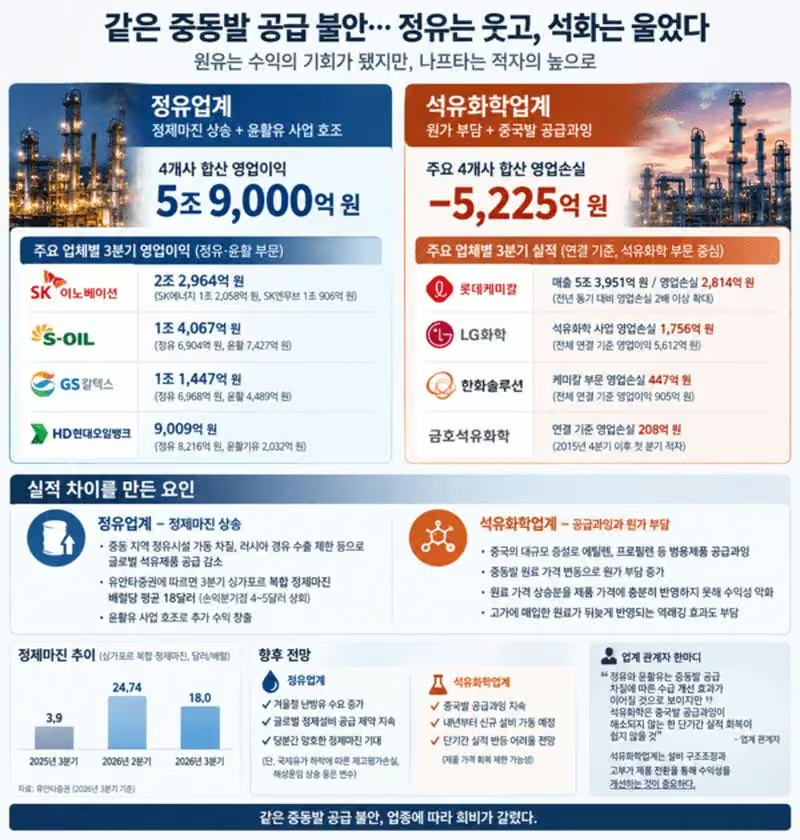
The four major South Korean refiners posted a combined operating profit of 5.9 trillion won in the third quarter, driven by strong performance in their refining and lubricants segments. The surge in results was primarily attributed to an increase in the crack spread, which significantly boosted margins across the industry.
In contrast, the four leading petrochemical companies reported a collective loss of 52.25 billion won for their petrochemical divisions during the same period. Rising production costs weighed heavily on profitability, leading to a sharp deterioration in financial performance for these firms.
While the refining sector has seen a rapid improvement in earnings due to better supply and demand dynamics, the petrochemical industry continues to struggle with a recovery. An oversupply of products from China remains a persistent headwind, complicating efforts to restore profitability in the sector.
South Korea’s refining and petrochemical sectors posted sharply diverging results for the third quarter of this year. Refiners posted substantial operating profits, buoyed by higher refining margins stemming from supply disruptions in the Middle East and strong performance in their lubricant businesses. In contrast, petrochemical companies posted consecutive losses, weighed down by rising input costs and an oversupply of products from China. The same supply instability originating in the Middle East thus acted as a driver of improved profitability for refiners while simultaneously worsening the financial performance of petrochemical firms.
According to industry data released on the 10th, the combined operating profit from the refining and lubricant segments of the country’s four major refiners—SK Innovation, S-Oil, GS Caltex, and HD Hyundai Oilbank—totaled 5.9 trillion won in the third quarter. By comparison, the combined operating loss from the petrochemical segments of Lotte Chemical, Kumho Petrochemical, LG Chem, and Hanwha Solutions reached 522.5 billion won.
All four refiners recorded high profitability, driven by strong refining margins and robust lubricant sales. SK Innovation, in particular, generated 1.2058 trillion won in operating profit from its refining subsidiary SK Energy and 1.0906 trillion won from its lubricant subsidiary SK Enmuv, totaling 2.2964 trillion won across these two business lines.
S-Oil also reported a consolidated operating profit of 1.4067 trillion won for the third quarter, a 513.7% increase from the same period last year. The company posted 690.4 billion won in operating profit from its refining segment and 742.7 billion won from its lubricant segment. Notably, operating profit in the lubricant segment exceeded that of the refining segment, underscoring the benefits derived from a global shortage of lubricant base oils.
GS Caltex and HD Hyundai Oilbank also posted substantial profits. GS Caltex’s consolidated operating profit for the third quarter was 1.1447 trillion won, up 207.6% year-on-year, with operating profits of 696.8 billion won and 448.9 billion won from its refining and lubricant segments, respectively. HD Hyundai Oilbank’s consolidated operating profit rose 371.2% from the same period last year to 900.9 billion won, supported by operating profits of 821.6 billion won in refining and 203.2 billion won in lubricant base oils.
The situation in the petrochemical sector was starkly different. Lotte Chemical reported third-quarter consolidated revenue of 5.3951 trillion won and an operating loss of 281.4 billion won. Although revenue increased 12.7% year-on-year, the operating loss more than doubled from 132.6 billion won in the same period last year. The company had just returned to profitability in the second quarter with an operating profit of 110.1 billion won, only to slip back into the red a single quarter later.
LG Chem also posted an operating loss of 175.6 billion won in its petrochemical division. While the company’s consolidated operating profit reached 561.2 billion won, driven by its battery and advanced materials segments, the petrochemical unit swung to a deficit from a 29 billion won profit in the same period last year. Hanwha Solutions reported a total operating profit of 90.5 billion won, but its chemicals segment incurred an operating loss of 44.7 billion won.
Kumho Petrochemical, which had previously maintained relatively stable profitability, also failed to avoid losses. The company recorded a consolidated operating loss of 20.8 billion won in the third quarter, marking its first quarterly deficit since the fourth quarter of 2015. Operating profit from its core synthetic rubber business was limited to 2.3 billion won, while the synthetic resin division generated a loss of 13.9 billion won.
This performance gap stems from the distinct supply and demand dynamics of the refining and petrochemical industries. The refining sector has sustained high refining margins due to reduced global petroleum product supply, driven by operational disruptions at Middle Eastern refineries and Russia’s export restrictions on diesel. According to Yuanta Securities, the average Singapore composite refining margin in the third quarter of this year stood at $18 per barrel, significantly exceeding the $4 to $5 per barrel level typically cited as the break-even point for refiners.
In contrast, the petrochemical industry continues to face oversupply of commodity products such as ethylene and propylene, exacerbated by large-scale capacity expansions in China, alongside volatility in raw material prices originating from the Middle East. Petrochemical companies, which process naphtha extracted from crude oil to produce finished goods, have struggled to pass on rising input costs to product selling prices, leading to deteriorating margins. The lag effect, where high-cost raw materials are reflected in production costs with a delay, has further weighed on profitability.
Outlook for the two sectors also diverges. Refiners anticipate that favorable refining margins will persist in the near term, supported by winter heating oil demand and ongoing constraints on global refining capacity.
Conversely, the petrochemical sector is unlikely to see a short-term rebound in performance. With the China-driven oversupply unresolved and new petrochemical facilities scheduled to come online starting next year, product price recovery may remain limited.
An industry official noted, "While supply and demand improvements from Middle Eastern disruptions are expected to continue benefiting refining and lubricants, petrochemicals will face challenges in achieving short-term performance recovery as long as China-driven oversupply persists." The official added that the petrochemical industry must focus on improving profitability through facility restructuring and a shift toward high-value-added products.
Chnchemicals take
The stark divergence between refining profits and petrochemical losses signals a structural imbalance in the global chemical supply chain. While Middle Eastern disruptions temporarily boost refining margins, the persistent oversupply from China continues to suppress petrochemical margins, forcing producers to prioritize structural efficiency over volume growth. Investors should expect continued volatility in petrochemical earnings until the industry successfully shifts toward high-value-added products to offset these external pressures.
Frequently asked questions
Why did South Korean petrochemical companies report a collective loss in the third quarter?
Petrochemical divisions reported a collective loss of 52.25 billion won due to rising production costs and persistent oversupply from China. These factors weighed heavily on profitability, leading to a sharp deterioration in financial performance for the sector.
How does China-driven oversupply affect the outlook for South Korean petrochemical producers?
China-driven oversupply remains a persistent headwind that complicates efforts to restore profitability in the petrochemical sector. Industry officials note that short-term recovery is unlikely as long as this supply imbalance persists, requiring a shift toward high-value-added products.