China: How a single carbon fiber thread travels from the Yangtze River Delta to Yulin
Key facts
- Yulin Hengshen New Materials Project is Shaanxi's first 10,000-ton-class high-performance carbon fiber production facility
- Carbon fiber production involves precursor spinning in Danyang, Jiangsu, and carbonization in Yulin, Shaanxi
- The project team implemented adaptive modifications to address static electricity risks caused by Yulin's low humidity and high wind conditions
- Carbon fibers produced in Yulin serve as structural components for wind turbine blades and drone frames
- The collaboration represents a shift from livelihood assistance to joint construction of science, technology, and industry between Jiangsu and Shaanxi
Editor’s Note: A single wind turbine blade is held together by carbon fibers thinner than a human hair. These fibers originate in workshops in Danyang, Jiangsu Province, before undergoing spinning and carbonization in the arid landscapes of Yulin, Shaanxi Province, ultimately forming the structural backbone of turbine blades and drone frames. This trajectory represents more than just a cross-regional collaboration; it serves as a case study in Shaanxi’s strategic push into the new materials sector. Using this as a starting point, we launch a series titled “Carbon Visits Shaanxi: The Future of New Quality Productivity,” which explores how a single carbon fiber has traveled from the Yangtze River Delta to Shaanxi, how a team has evolved from following to leading, and how the upstream and downstream segments of this industrial chain have become tightly interlocked.
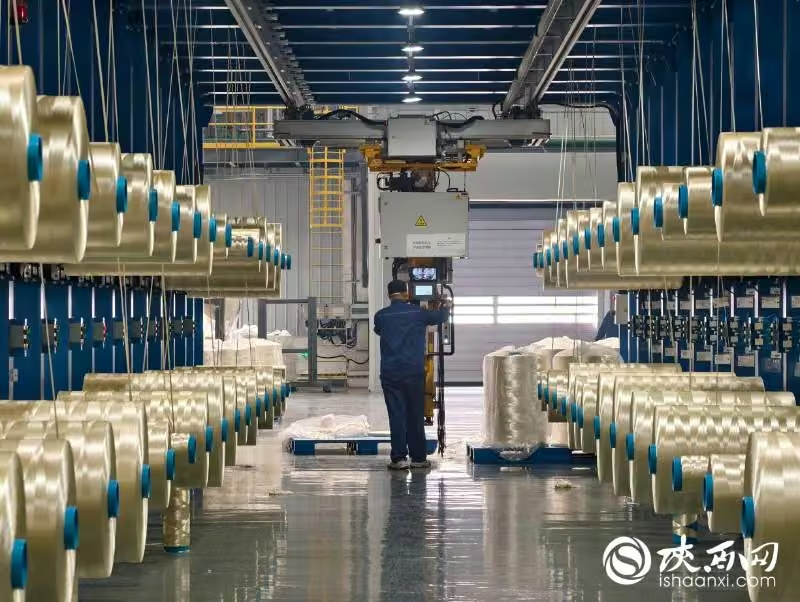
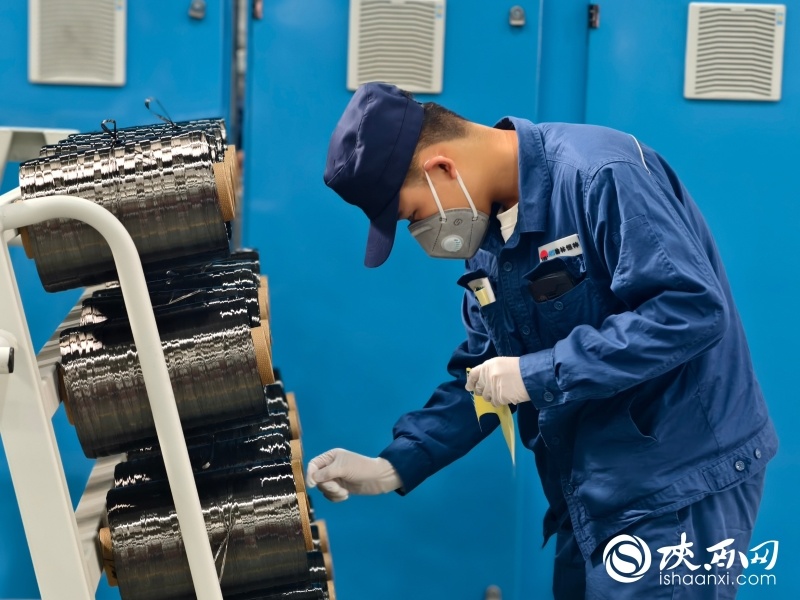
Inside the carbonization workshop, the roar of machinery fills the air. Pristine white precursor fibers undergo multiple stages of processing, transforming into rolls of glossy, high-performance black carbon fiber. Recently, the first phase of the Yulin Hengshen New Materials Project, Shaanxi’s first 10,000-ton-class high-performance carbon fiber production base, completed its handover acceptance.
The technical expertise and talent supporting this production line come from Danyang, Jiangsu. By establishing a permanent presence in Yulin, these professionals have enabled a single carbon fiber to bridge a thousand kilometers, linking the two regions in a vivid example of industrial cooperation between Jiangsu and Shaanxi.
Energy and chemical industries serve as the ballast for Shaanxi’s industrial economy. However, relying solely on resource exports makes it difficult for the industry to achieve upward breakthroughs. How to deploy high-value-added new materials has become an unavoidable practical challenge for Yulin’s industrial transformation.
Carbon fiber is a capital-intensive sector characterized by high initial investment, long construction cycles, and extended payback periods. As one of the earliest domestic companies to layout the full carbon fiber industry chain, Jiangsu Hengshen Co., Ltd. (hereinafter referred to as Hengshen) faced operational pressures in its early years, with the market consistently debating the sector’s return on investment.
In 2018, Shaanxi Coal Group, a traditional energy giant, entered the strategic emerging industries sector by conducting a strategic restructuring of Hengshen, a critical move in its transformation.
Questions immediately arose: How should the acquired carbon fiber technology be implemented? The goal was not merely a financial investment, but to genuinely serve local Shaanxi interests and assist in industrial upgrading.
“Many of Shaanxi’s key industrial chains, such as military, automotive, photovoltaic, and low-altitude economy sectors, are highly relevant to carbon fiber,” said Liu Jin, Party Secretary, Chairman, and General Manager of Hengshen. He noted that Shaanxi offers abundant application scenarios and complementary industrial chain advantages, which provided the strategic direction for Hengshen to expand production in the province.
Consequently, a project with a total investment of over 4.7 billion yuan, designed to produce 20,000 tons of high-performance carbon fiber annually, was established. This project addressed the gap in large-scale carbon fiber mass production bases in Shaanxi, leading to the formation of Yulin Hengshen New Materials Co., Ltd. (hereinafter referred to as Yulin Hengshen).
“This is not a simple industrial transfer, but a ‘two-way journey,’” said Fang Xinjun, General Manager of Yulin Hengshen. He explained that Jiangsu brought decades of accumulated carbon fiber processes, technology, and talent, while Shaanxi provided unique energy resources, park infrastructure, and industrial capacity space. Together, these factors drove the implementation and rooting of high-end material technology in Yulin.
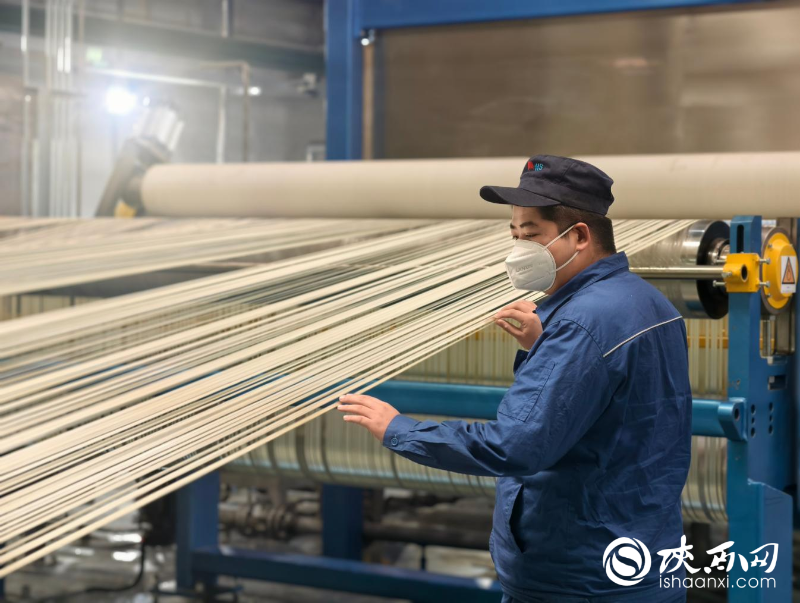
Adapting the mature carbon fiber processes from Danyang to the new production line in Yulin required systematic localization adjustments.
“Climate conditions, raw material specifications, and energy infrastructure differ significantly. Directly applying the original production parameters would make it difficult to guarantee product stability,” explained Yin Weitao, a dispatched cadre from Jiangsu Hengshen and Executive Deputy General Manager and Technical Director of Yulin Hengshen. He noted that the company formed a joint Jiangsu-Shaanxi technical team to conduct extensive adaptive modifications tailored to local climate and geographical characteristics.
Yulin experiences high wind and sand levels with low air humidity, which can generate static electricity in workshops. The project specifically optimized factory sealing, ventilation and exhaust systems, and access control management to ensure that workshop cleanliness and humidity met the strict standards required for chemical fiber production.
After multiple rounds of testing and refinement involving raw material adaptation, temperature control adjustments, and energy consumption matching, the carbon fiber technology from Danyang finally achieved true transformation in Yulin.
The recently completed Phase 1, Stage 1 of the project features the simultaneous construction of two production lines employing distinct technical processes within the same facility, a configuration that remains rare among domestic peers.
“One line is dedicated to 50k large-tow carbon fiber, meeting the performance specifications required for next-generation ultra-long wind turbine blades; the other focuses on dry-wet spinning 24k carbon fiber, targeting the hydrogen pressure vessel market,” explained Yin Weitao. He noted that the former achieves T700 performance standards, offering significantly higher application efficiency than small-tow products, while the latter covers diverse sectors including hydrogen energy, photovoltaics, and sports leisure.
Both production lines have now achieved full process integration, with certain products entering the validation phase with downstream clients. The company is proceeding with planned iterations of its manufacturing processes and market expansion.
“By dispatching key personnel from Jiangsu to provide mentorship and collaborating with local vocational colleges for customized training, Yulin Hengshen has gradually established its own industrial talent system,” Yin said. Most front-line employees are graduates from two local vocational technical colleges in Yulin. The workshop has even developed operational methods named after local staff, fostering technical innovation at the grassroots level.
Upon full completion, the project is expected to stimulate fixed asset investment and broaden employment opportunities in Yulin. It also aims to attract upstream and downstream industries, such as composite material deep processing and supporting equipment manufacturing, to cluster in the region, thereby amplifying industrial agglomeration effects.
For Yulin, the carbon fiber project serves as a critical pivot for extending its industrial chain and transitioning from a resource-exporting model to high-value-added new materials.
“There is substantial room for Jiangsu enterprises to invest in Shaanxi or for Shaanxi companies to collaborate with counterparts in Jiangsu,” admitted Liu Jin. He pointed out that the Jiangsu-Shaanxi cooperation framework offers significant scale and complementarity. Shaanxi can meet Jiangsu’s demand for upstream raw materials in precision chemicals and high-end manufacturing, while its energy endowments, educational and scientific resources, and geographic advantages position it well to absorb such collaboration.
In Hengshen Co.’s development strategy, Yulin Hengshen is designated as the primary base for the company’s “second entrepreneurship.” The site is tasked not only with capacity expansion but also with cultivating a local workforce of carbon fiber industry workers. While securing its position in high-end markets, the company aims to continuously explore application potential in mass-market segments.
“Yulin Hengshen’s capacity is being built in stages. Currently, 5,000 tons of capacity have been completed. Feasibility studies for the second stage’s 5,000 tons have begun, with a target to reach 10,000 tons of capacity by the end of 2027. The full 20,000-ton capacity is planned for completion by the end of the 15th Five-Year Plan period,” Yin revealed. The company is advocating for the implementation of a provincial coal-to-acrylonitrile project to address local raw material shortages, reduce production costs, and establish a complete innovative industrial chain for coal-based carbon fiber.
From Danyang to Yulin, a single carbon filament traverses hundreds of kilometers, vividly illustrating the shift of Jiangsu-Shaanxi cooperation from livelihood assistance to joint construction of science, technology, and industry.
As this new material filament, born of cross-provincial collaboration, is produced steadily in the highlands of Yulin, it accumulates the momentum for traditional energy regions to break into new competitive arenas.
Chnchemicals take
This cross-regional integration signals a strategic shift in China's new materials sector, where traditional energy hubs are becoming critical nodes in high-tech supply chains. By overcoming specific environmental challenges like static electricity in arid regions, producers can secure stable, high-volume output for renewable energy components. Investors should note that such localized adaptation reduces supply chain fragility, enabling more reliable sourcing for wind turbine and drone manufacturers who depend on consistent carbon fiber quality.
Frequently asked questions
What is the production capacity of the first phase of the Yulin Hengshen New Materials Project in Shaanxi?
The first phase of the Yulin Hengshen New Materials Project has a capacity of 10,000 tons. This facility is described as Shaanxi's first 10,000-ton-class high-performance carbon fiber production base.
How did Yulin Hengshen adapt its carbon fiber production process to the local environmental conditions in Shaanxi?
The company formed a joint Jiangsu-Shaanxi technical team to conduct adaptive modifications for local climate and geography. These changes addressed issues like static electricity caused by low air humidity and high wind levels in Yulin.
What industrial applications are highlighted for the carbon fiber produced in the Yulin Hengshen facility?
The carbon fiber produced in Yulin is used as the structural backbone for wind turbine blades and drone frames. This material is critical for the structural integrity of these high-performance equipment components.