Pupuk Indonesia Partners with Global Firms to Develop Amurea Fertilizer Plant in Fakfak, West Papua
Key facts
- PT Pupuk Kalimantan Timur is advancing the Fakfak Amurea plant project in West Papua with international partners
- The project involves Basic Engineering Design collaboration with Topsoe from Denmark and Toyo Engineering from Japan
- Pupuk Indonesia states the facility will strengthen national urea production capacity for food security
- The company positions the Fakfak project as a strategic step toward becoming a globally competitive petrochemical enterprise
PT Pupuk Indonesia (Persero), through its subsidiary PT Pupuk Kalimantan Timur, is advancing the Fakfak Ammonia-Urea (Amurea) plant project in West Papua by partnering with international technology and engineering firms from Denmark and Japan.
“Food security serves as the starting point for this project’s development. Beyond that, the Fakfak Amurea project also creates added value from natural gas potential through technology and innovation,” said Rahmad Pribadi, President Director of Pupuk Indonesia, in a statement issued in Jakarta on Sunday.
He noted that this initiative is marked by a collaboration on the Basic Engineering Design (BED) with two international technology and engineering companies: Topsoe from Denmark and Toyo Engineering Corporation (TOYO) from Japan.
The company described the development of the Amurea Fakfak facility as a strategic move to bolster national food security while accelerating industrial growth in eastern Indonesia. The project is also positioned as a key component of Pupuk Indonesia’s broader strategy to evolve into a globally competitive petrochemical enterprise.
"This project will serve as a catalyst for industrialization in Eastern Indonesia and strengthen Pupuk Indonesia’s standing in the global petrochemical industry," the official stated.
Rahmad noted that the Amurea Fakfak industrial complex is designed to produce approximately 825,000 tons of ammonia and 1.15 million tons of urea annually.
To equip the ammonia production unit, Pupuk Indonesia entered into an agreement with Topsoe, signed in Copenhagen on November 13, 2026. The contract covers the licensing of the SynCOR Ammonia technology and the development of the BED system.
The Fakfak ammonia facility will be the first in Indonesia to utilize Topsoe’s SynCOR Ammonia™ technology. This innovation is projected to reduce natural gas consumption, a key feedstock, by up to 10 percent compared to conventional processing methods.
The facility is designed with a ready-to-blue approach, allowing for the integration of carbon capture and storage (CCS) or carbon capture, utilization and storage (CCUS) technologies in subsequent development phases.
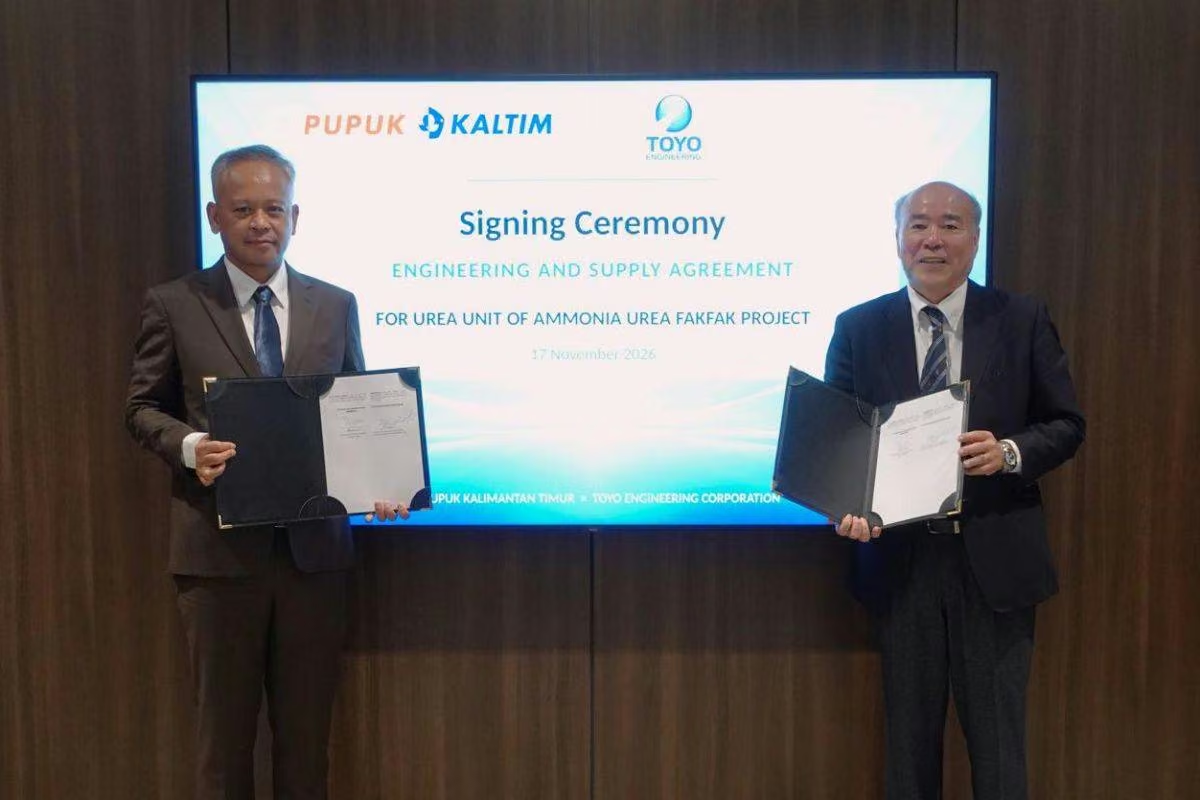
Meanwhile, the partnership with TOYO, signed in Tokyo on November 17, 2026, covers the development of the BED for the urea production facility, which will utilize ACES21™ technology. This technology is engineered to enhance energy efficiency and lower the investment costs associated with plant construction.
"We are developing the Fakfak project with state-of-the-art technology and global standards. This development will strengthen national urea production capacity. Once domestic demand is met, this capacity expansion opens opportunities for Indonesia to contribute to food security in the regional and Asia-Pacific areas," he said.
The completion of the Basic Engineering Design (BED) serves as a critical technical foundation for advancing the Fakfak Amurea Plant project to its next phase, which includes securing final investment approval and initiating the tender process for Engineering, Procurement, and Construction (EPC).
As the technical design progresses, Pupuk Indonesia and Pupuk Kaltim are continuing site-specific technical studies and preparing the necessary permits to support subsequent project stages. The companies are ensuring that the project is executed with prudence and strong corporate governance, underpinned by comprehensive feasibility studies and measured risk mitigation strategies.
The development of the Fakfak Amurea Plant is part of Pupuk Indonesia’s industrialization agenda, which encompasses the construction and revitalization of eight plants over the next five years.
By enhancing production capacity and efficiency, alongside diversifying into high-value-added chemical industries, Pupuk Indonesia aims to strengthen national industrial self-reliance while ensuring a sustainable fertilizer supply to support food self-sufficiency.
Chnchemicals take
This expansion signals a significant shift in Indonesia's fertilizer supply chain, aiming to reduce import dependence by leveraging local natural gas resources. By integrating advanced international engineering standards, the project enhances operational reliability and output consistency, which is critical for stabilizing regional agricultural inputs. Investors should monitor how this capacity addition affects global urea trade flows, as increased domestic production may alter export dynamics in the Asia-Pacific market.
Frequently asked questions
Which international engineering firms are collaborating with Pupuk Indonesia on the Fakfak Amurea project?
Pupuk Indonesia is collaborating with Topsoe from Denmark and Toyo Engineering Corporation from Japan. These firms are supporting the Basic Engineering Design for the new ammonia-urea facility.
What is the primary strategic objective of the Fakfak Amurea plant for Pupuk Indonesia?
The project aims to bolster national food security and accelerate industrial growth in eastern Indonesia. It is also a key component of the company's strategy to become a globally competitive petrochemical enterprise.
How does the Fakfak project impact Indonesia's urea production capacity and regional food security?
The facility will strengthen national urea production capacity using state-of-the-art technology. Once domestic demand is met, the expansion creates opportunities for Indonesia to contribute to food security in the Asia-Pacific region.